

The most visible local expert isn’t always the best-connected. To find local community experts, combine AI-powered discovery and local search with trusted community connections. Each can reveal different people, groups, and services nearby, giving you a fuller picture before you decide whom to contact.
It’s natural to want a relevant recommendation, not just a name at the top of a list. Local knowledge and shared interests add useful context to what digital tools surface.
This guide explains how to use AI, community connections, local search, and apps to discover experts nearby. You’ll learn what each approach can reveal and how to combine them to make finding local support more straightforward.
Key Takeaways
- Use specific location and skill details in AI recommendations to surface people whose expertise fits your needs.
- Pair online discovery with community connections and reviews to add local context and trust.
- Look for neighborhood-specific language and useful local information when assessing search results.
- Explore apps that bring community listings and events together; Sahayy’s Community Marketplace can help you discover local listings.
1. AI-generated local recommendations
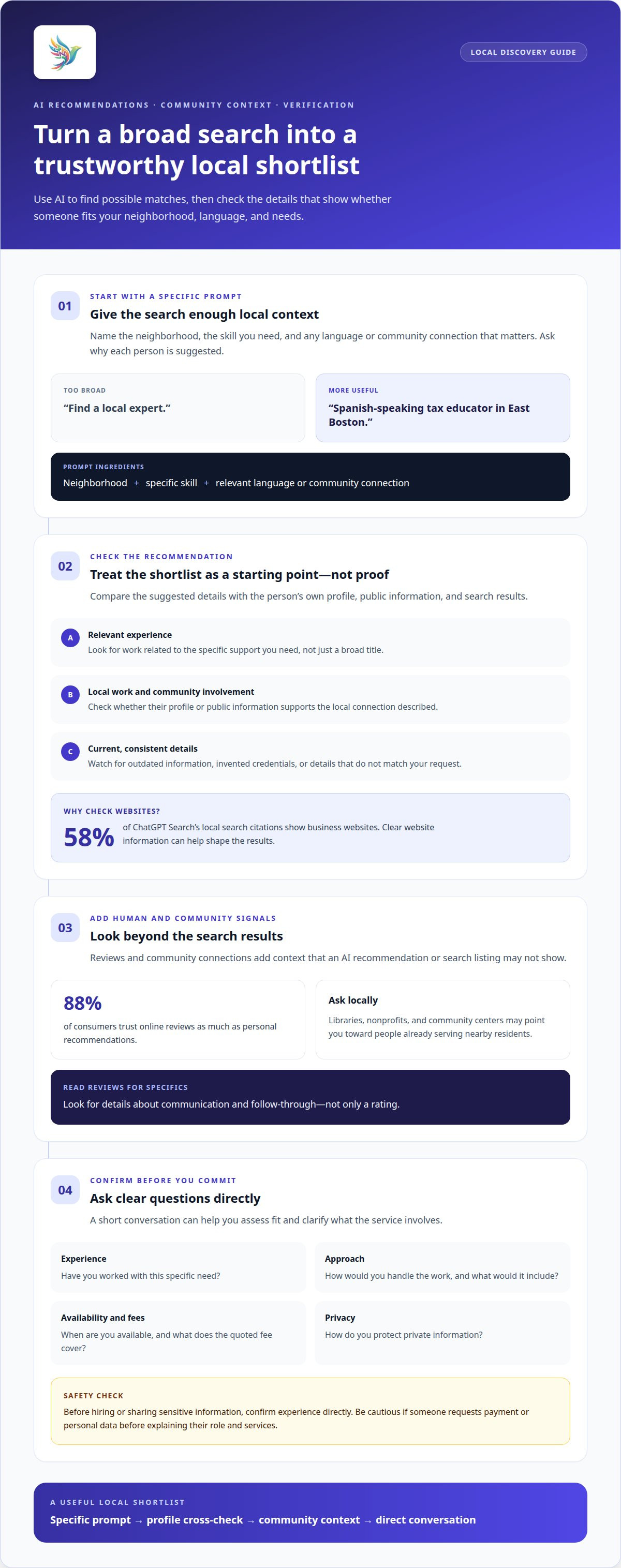
AI recommendations can turn a broad question into a shortlist of nearby people and organizations. For example, ask for a Bengali-speaking community organizer in Queens, rather than simply asking for a local expert. ChatGPT Search shows business websites for 58% of its local search citations, so clear website information can help shape the results. Treat recommendations as starting points, not proof of someone’s expertise.
Make your request specific. Name the neighborhood, the skill you need, and any language or community connection that matters. Ask why each person is suggested, such as their relevant experience, local work, or community involvement. Compare those details with search results and public profiles. Use a focused query, such as “Spanish-speaking tax educator in East Boston,” rather than “local expert.”
To find experts who match a particular neighborhood, language, or community need, include those details in your prompt and try related terms. Asking for a “Somali-speaking youth mentor near Cedar-Riverside” gives an AI tool more context than “find a mentor.” If the results are too broad, add a nearby landmark or describe the support you need.
Watch for outdated details, invented credentials, and suggestions that don’t match your request. Before hiring someone or sharing sensitive information, review their own profile and confirm their experience directly. Be cautious if someone requests payment or personal data before explaining their role and services. AI can suggest people, but your judgment and a direct conversation help you assess whether they’re a good fit.
88% of consumers trust online reviews as much as personal recommendations. Dayna Lucio recommended brands provide users the information they seek on Google Business Profile profiles and on-page content, and continue to pay attention to reviews.
Map 15 to 20 hyperlocal entities for local SEO; publish neighborhood updates monthly, partner spotlights quarterly, and seasonal event tips. Aim for mobile Google PageSpeed Insights score 90+ and use at least 16-pixel text.
2. Community relationships and local SEO
Local libraries, nonprofits, and community centers can point you toward people already serving nearby residents. Ask staff about relevant programs, workshops, or neighborhood groups. For example, a library’s small-business session may connect you with a local business mentor. In-person referrals add context that search engines can’t show, while community partners can strengthen trust and local visibility.
Businesses can build a useful local presence by answering real questions from the community. A neighborhood nonprofit, for example, might publish a guide to finding food assistance and share it through local partners. Keep location details and service descriptions consistent across public listings. Clear, practical information helps people and search engines understand whom the business serves.
Fees vary with an expert’s field, experience, location, and the work involved. Some offer free consultations; others charge for an initial meeting. Ask about consultation terms and request a quote before agreeing to paid work.
Look for experience relevant to your needs, such as work in the field, community involvement, or credentials related to the task. A community health educator and a small-business adviser require different expertise. Check public reviews, ask for references, and compare claims across profiles. For sensitive or regulated work, confirm that any required credentials apply to the specific role.
Before hiring, ask about the expert’s experience with your specific need, their approach, expected deliverables, and fees. Request an example of similar work and ask how they protect private information. For a digital starting point alongside in-person referrals, explore local community connections.
3. Connecting with professionals through an app
Apps and online directories can make local expertise easier to browse from one place. Search Google Maps for a specialty and neighborhood, then compare those results with community platforms and professional directories. Each platform organizes profiles differently, so review the person’s listed experience, services, location, and contact options. A profile that clearly describes work with your community gives you more useful detail than a broad title alone.
Compare professionals using the same criteria: specialty, relevant experience, availability, and stated fees. A language tutor might offer conversation practice, while a neighborhood business adviser describes startup support. Contact promising experts to ask about availability and what their quoted fee covers. Ratings provide context, but read review comments for specific details about communication and follow-through.
Which websites and directories list local community experts? Search engines and maps can surface nearby businesses and services, while professional directories and community platforms may organize people by specialty or location. Search for a neighborhood and a specific skill, then check whether each result has a complete profile and recent activity. Compare listings across platforms instead of relying on a single search result.
Before sharing private details, review the person’s profile and use the platform’s contact features to understand whom you’re reaching. Keep your first message focused: describe your need, preferred language, and location. Then ask about relevant experience, availability, and fees. A clear message helps both sides decide whether a conversation makes sense.
Mobile users are 2.4 times more likely to tap the call button directly from a listing. If calling suits your needs, use the button to ask focused questions about experience, availability, fees, and the next steps. Keep the conversation brief, and avoid sharing private details until you understand who you are speaking with.
Sahayy: Community Marketplace
Sahayy brings local connections together through its Community Marketplace and Sahayy Mobile App. If you’re looking beyond search listings for community-relevant services and connections, the marketplace offers a place to discover local listings. Event Discovery and Posting can help you find or share community events, while Commy AI Assistant can respond to queries in multiple languages.
Use Sahayy when you’re settling into a new area or looking to connect through shared interests. Explore Berlin communities, service listings, and events in one app, then decide which connections fit your needs. You can join groups, discover events, or post a listing, with core features free to use.
Take the next step toward local connection
A good way to find local community experts is to start with the need that matters most right now. Choose one practical goal, such as meeting people who share your language or learning about a neighborhood resource. Then take a small step, like joining a relevant community conversation or attending an event that feels welcoming.
Building familiarity takes time, and genuine interactions can make a new place feel more approachable. Stay curious, share only what you’re comfortable sharing, and let your interests guide the people and opportunities you explore. A stronger sense of belonging can start with one useful conversation.
Your next meaningful local connection may be closer than you think.
Frequently Asked Questions
What are the best ways to find local community experts near me?
Start with the help you need, then explore neighborhood groups, professional directories, and community events. For example, if you’re looking for a gardening mentor, attend a neighborhood planting day and ask organizers who leads shared projects. A brief conversation can help you understand someone’s experience and approach before arranging a longer consultation.

Article by
Vinay Patil
Vinay Patil is the founder of Sahayy, a community platform inspired by his own experience of moving to a new country and having to figure out things that someone already there could have answered in minutes. He believes that belonging is built through small acts of helping — sharing an event, answering a question, recommending a service, or simply connecting someone with the right people. With nearly two decades of experience in technology, Vinay is building Sahayy to make it easier for people to find trusted communities and feel at home, wherever they are in the world.
More at https://vinaypatil.com


