
A nearby mothers’ meetup may not require membership. Searching for an international mothers group near me can lead you to an open gathering or a group that asks you to register first. It’s reasonable to find out what to expect before you go, especially if you’re new to the area or bringing your child.
What you can expect depends on the group: some meet weekly, while others gather twice a month. Registration may also help organizers share practical details, such as the meeting location. This guide explains how membership and registration can differ, what inclusive family meet-ups may involve, and the kinds of social events or workshops mothers can find. You’ll have a clearer sense of how to choose a gathering that feels comfortable for you and your family.
Key Takeaways
- Look for a group whose welcome and activities fit your family’s circumstances, including your child’s age and your connection to the local community.
- Meet-ups may offer more than conversation, with opportunities for cultural exchange, family connections, and practical information.
- Explore social gatherings, service projects, and workshops to find a comfortable way to take part and build local connections.
- Use Sahayy’s event discovery and posting to find community activities, with the app’s other tools supporting local connection.
In-person mom groups and meetings
Local meet-ups vary in schedule, focus, and registration requirements. Treat registration as a step for attending unless the group separately describes membership.
Local Groups for Immigrant and Expat Mothers
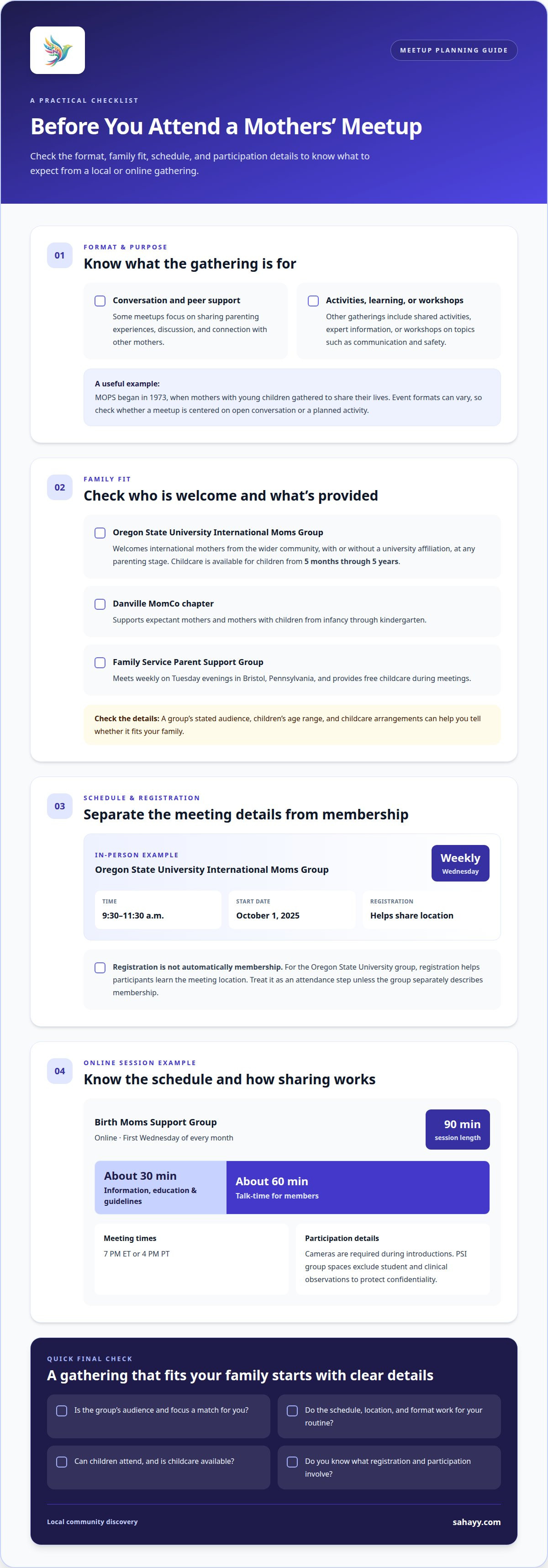
The Oregon State University International Moms Group welcomes international mothers from the wider community, whether or not they’re affiliated with the university. Its weekly Wednesday meetings run from 9:30 to 11:30 a.m., starting October 1, 2025. Childcare is available for children from 5 months through 5 years. This offers a concrete example of a support group for mothers adjusting to life across cultures. Registration helps participants learn the meeting location.
Language and Nationality Groups
Yes, some local communities form around shared languages or national backgrounds, though they may not be mothers-only groups. For example, Indian community groups in Berlin offer a way to explore culturally focused gatherings. Look at each group’s stated audience and activities to see whether it suits your family and helps you connect with other mothers.
For a monthly online option, the Birth Moms Support Group meets on the first Wednesday of every month at 7 PM ET or 4 PM PT. Sessions last 90 minutes. This schedule can suit mothers seeking peer support remotely, rather than an in-person local meeting.
Before attending, distinguish registration from membership. The Oregon State University group asks participants to register to learn its weekly meeting location. Check the format, schedule, and whether children can attend. These details help you find a gathering that fits your routine and know what to expect.
Inclusive family community and meet-ups
Family meet-ups can connect mothers across cultures and parenting stages, offering ways to make friends and find local support. A group’s audience and activities can help you decide whether it suits your family.
Yes. The Oregon State University International Moms Group welcomes international mothers at any parenting stage, whether or not they’re affiliated with the university. The Danville MomCo chapter also supports expectant mothers and mothers with children from infancy through kindergarten. These examples show that some groups welcome families before birth and throughout a child’s early years. Check the group’s stated age range and community focus before joining.
Family resources can combine shared learning with social time. At Oregon State University’s group, local experts regularly share information about health, family, and the wider world. Parent to Parent Connections of Northumberland County, a parent-created network in Sunbury, offers meetings and workshops on communication and safety. These gatherings can provide practical ideas as well as opportunities to meet other families.
Some programs build cultural exchange into their gatherings. Oregon State University’s American Thanksgiving Program pairs international families with American host families for a Thanksgiving meal. Its Moms Crossing International Borders program connects international mothers with American mothers whose children are a similar age, or with mentor mothers. Both formats give families space to share traditions and learn from one another.
Community support can also include hands-on help. MOMS Club chapters organize service projects intended to benefit mothers and children. Family Service’s Parent Support Group in Bristol, Pennsylvania, meets weekly on Tuesday evenings and provides free childcare during meetings. For another way to explore community resources, find local family connections.
Social events and workshops for mothers
Local international mothers groups may offer social events, peer support, or guided discussions. Formats vary, so review each group’s event focus and participation details. Some gatherings center on conversation; others bring members together for shared activities.
MOPS began in 1973, when mothers with young children gathered to share their lives. Sharing parenting journeys can make discussion a central part of a gathering. For a first visit, notice whether the event invites open conversation or centers on a planned activity. Choose an event whose purpose matches the connection you want, and check whether children are part of it.
The online Birth Moms Support Group structures its session in two parts. About 30 minutes cover information, education, and group guidelines. Members hear the guidelines before discussion. The talk-time portion lasts about 60 minutes, giving members dedicated time to speak. Cameras are required during introductions. PSI group spaces exclude student and clinical observations to protect confidentiality and create a safe space. These details clarify participation expectations before members share.
A MOMS Club chapter’s 30th-anniversary celebration shows how group ties can last. One attendee had been involved with that chapter since 2011. At a social event, notice whether the format gives newcomers an easy way to join discussion. A clear event purpose can help you choose a comfortable first step.
Sahayy
Sahayy brings together local events, groups, services, and marketplace listings to help people who have moved abroad find community. Use the Sahayy Mobile App to explore Events and community Groups, including gatherings for mothers and families. Commy, Sahayy’s AI assistant, answers queries in multiple languages based on what is posted in your community, not the open internet.
Event details can help you choose a gathering that fits your family and interests. Sahayy’s core features are free to use, so you can explore local community listings and share an event without a listing fee. Find a local activity or post an event in the Sahayy app.
Make your next connection a simple one
Choosing an international mothers group near me can start with one practical question: what kind of gathering would feel manageable to attend? Let your interests, family routine, and comfort with new settings guide your choice. You don’t need to plan a full social calendar at once. One event can be a first step toward meeting familiar faces and building community in your own way.
If you’d like help finding local connections, contact Sahayy about joining.
Every community begins with people showing up. Take the next step at a pace that feels right for you and your family.
Frequently Asked Questions
Is Membership Required to Join a Group?
Not always. Some groups welcome visitors without ongoing membership, while others organize activities for registered members. Registration may have a separate purpose, such as sharing event details or managing attendance. Look for information about joining, registration, and participation to find out whether you can attend once or need to become a member.
What international mothers groups are near me?
Nearby options depend on your community and the social connection or support you’re looking for. Search local listings by city or neighborhood, then compare group descriptions for their audience, activities, and whether children can attend. An international mothers group near me might be a mothers-only circle, a wider parent community, or a cultural group that welcomes families.
Where and when do nearby international mothers groups meet?
Each group sets its own venue and schedule. Check event details for the meeting place, day, time, and whether it’s in person or online. If a listing gives only a general location, registration may provide the exact venue. Compare the schedule with your routine before deciding which gathering to attend.
How can I find local chapters of international parenting organizations?
Search the organization’s name with your city or neighborhood, then look for its chapter directory or local group listing. Compare each chapter’s audience, activities, and participation details. A chapter for parents of young children may suit one family, while a broader community group may better fit another parenting stage.
How much do local international mothers groups cost, and are there membership fees?
There is no single fee for every local group. Each organization sets its own membership and event policies, so distinguish recurring membership from attending an individual gathering. Sahayy’s core app features are free to use, but independent groups set their own fees. Review a group’s fee details before deciding to join.

Article by
Vinay Patil
Vinay Patil is the founder of Sahayy, a community platform inspired by his own experience of moving to a new country and having to figure out things that someone already there could have answered in minutes. He believes that belonging is built through small acts of helping — sharing an event, answering a question, recommending a service, or simply connecting someone with the right people. With nearly two decades of experience in technology, Vinay is building Sahayy to make it easier for people to find trusted communities and feel at home, wherever they are in the world.
More at https://vinaypatil.com


