

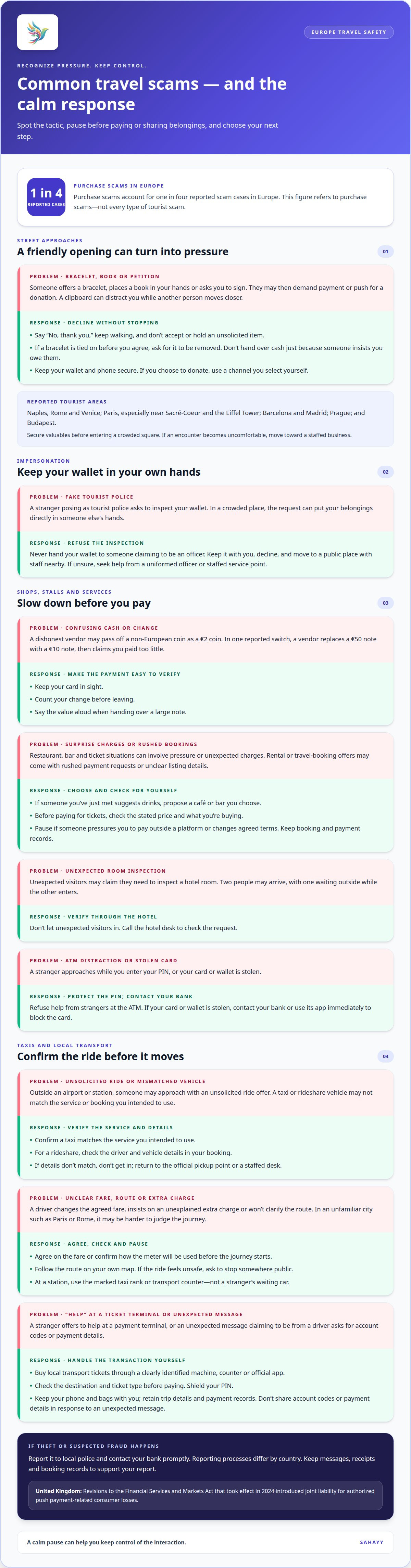
Purchase scams account for one in four reported scam cases in Europe, although that figure covers purchase scams, not every type of tourist scam. Common scams targeting foreigners in Europe also include street approaches involving bracelets, books or petitions, and attempts to confuse you during a purchase. Knowing the warning signs can help you respond calmly.
It’s understandable to want to enjoy a trip without second-guessing every friendly approach or payment. This guide explains how bracelet and petition tricks work, what to do if someone pressures you, and how to reduce the risk of purchase scams. You’ll also find practical ways to handle suspicious situations and keep your plans on track.
Key Takeaways
- Spot when a street approach involving a bracelet, book, or petition turns into pressure, and learn how to respond without getting drawn in.
- Use simple payment habits to make purchase tricks harder, including keeping your card in sight and counting your change.
- Know what to pay attention to before accepting a ride or settling a transportation fare in an unfamiliar city.
- Explore local events and communities through Sahayy to find ways to connect while living or traveling abroad.
2. Bracelet, book, and petition scams
On busy streets, someone may offer a bracelet, place a book in your hands or invite you to sign a petition. The approach can seem friendly, but the person may then demand payment or pressure you to donate. A clipboard can also distract you while another person moves closer. You can decline without stopping: say “No, thank you,” keep walking, and don’t accept or hold an unsolicited item.
If someone ties a bracelet around your wrist before you agree, stay calm. Ask them to remove it, and don’t hand over cash just because they insist you owe them. With a book or petition, keep your wallet and phone secure, and don’t reach for money while strangers crowd around you. If you want to support a cause, choose a donation channel yourself rather than responding to pressure on the street.
These approaches have been reported in tourist areas including Naples, Rome and Venice; Paris, especially near Sacré-Coeur and the Eiffel Tower; Barcelona and Madrid; Prague; and Budapest. Busy landmarks can make it harder to notice who is nearby. Secure your valuables before entering a crowded square, and move toward a staffed business if an encounter becomes uncomfortable.
Another street scam involves thieves posing as tourist police and asking to inspect your wallet. Never hand your wallet to someone claiming to be a police officer. Keep it with you, decline the inspection, and move to a public place with staff nearby. If you’re unsure about an official request, seek help from a uniformed officer or a staffed service point rather than letting strangers handle your belongings.
3. Purchase scams across Europe
Purchase scams account for one in four reported scam cases in Europe. At a market stall or shop, a dishonest vendor may pass off a non-European coin as a €2 coin. Count your change before leaving, keep your payment card in sight, and say the value aloud as you hand over a large note. In one reported currency-switching trick, a vendor swaps a €50 note for a €10 note, then claims you paid too little.
Restaurant, bar and ticket scams can involve pressure or surprise charges. If someone you’ve just met suggests going for drinks, propose a café or bar you choose. Before paying for tickets, check the stated price and what you’re buying.
Accommodation scams may involve unexpected visitors claiming they need to inspect a hotel room. Two people may arrive, with one waiting outside while the other enters. Don’t let unexpected visitors in; call the hotel desk. For rental or travel-booking offers, treat rushed payment requests and unclear listing details as warning signs, and keep your booking and payment records.
At an ATM, refuse help from strangers who approach while you enter your PIN. If your card or wallet is stolen, contact your bank or use its app immediately to block the card. For romance, online marketplace or booking transactions, pause if someone pressures you to pay outside the platform or changes the agreed terms.
Reporting processes differ by country. Report theft or suspected fraud to local police and contact your bank promptly. In the United Kingdom, revisions to the Financial Services and Markets Act that took effect in 2024 introduced joint liability for authorized push payment-related consumer losses. Keep messages, receipts, and booking records to support your report.
3. What taxi, rideshare, and transportation scams should visitors watch for in Europe?
Outside a European airport or station, be cautious if someone approaches with an unsolicited ride offer. Before getting into a taxi, confirm that the vehicle matches the service you intended to use. For a rideshare, check the driver and vehicle details in your booking. If they don’t match, don’t get in; return to the official pickup point or a staffed desk.
Agree on the fare or confirm how the meter will be used before the journey starts. If a driver changes the agreed fare, insists on an unexplained extra charge or refuses to clarify the route, pause before continuing. In an unfamiliar city such as Paris or Rome, follow your route on your own map. If the ride feels unsafe, ask to stop somewhere public.
At a train station, use the marked taxi rank or transport counter rather than following a stranger to a waiting car. Keep your phone and bags with you while arranging a ride. For app bookings, retain the trip details and payment record. Don’t share account codes or payment details in response to an unexpected message claiming to be from a driver.
For buses, trains and other local transport, buy tickets through a clearly identified machine, counter or official app. Check the destination and ticket type before paying. If a stranger offers to “help” at a payment terminal, handle the transaction yourself and shield your PIN. These steps can help you spot pressure tactics before they disrupt your journey.
Sahayy
Sahayy helps people living abroad connect with local communities and everyday resources. Knowing how street, purchase and transport scams work is one way to navigate unfamiliar places; building trusted local connections can help, too. The Sahayy Mobile App brings community groups, local events, services and a marketplace together. With Event Discovery and Posting, users can find or share gatherings, while Commy, the AI assistant, answers queries in multiple languages based on what’s posted in the community.
Use Sahayy to discover community activity and find local context as you settle into a new place. A marketplace listing or community connection isn’t a substitute for checking a seller or ride, but connecting with people nearby can help you feel less alone as you navigate daily life abroad.
Contact Sahayy to learn more about connecting with your local community.
Build confidence for your next journey
Understanding common scams targeting foreigners in Europe gives you a stronger starting point, but confidence also grows through local knowledge and connection. As you settle into a new place, take time to learn how daily routines work and where to find community context. Small, thoughtful choices can help you feel more grounded as you explore.
Keep your own pace when an unfamiliar interaction feels rushed. Give yourself permission to pause, step away or choose a different option. If you’re living abroad, finding people who understand the experience can make new surroundings feel more familiar. Sahayy brings people and local communities together, offering another way to build those connections.
Stay curious, trust your judgment and let local connections help you feel at home wherever the road takes you.
Frequently Asked Questions
How common are tourist scams in Europe?
Purchase scams account for one in four reported scam cases in Europe, but that figure doesn’t measure every tourist scam. Common scams targeting foreigners in Europe vary by destination and situation, so the statistic doesn’t predict your personal risk. It does show that purchase fraud makes up a substantial share of reported scams.
What are the most scammed countries in Europe?
The information covered here doesn’t establish a reliable Europe-wide ranking. Tourist scams are associated with destinations in Italy, France, Spain, the Czech Republic and Hungary, but that doesn’t show which country has the highest rate. Risks also vary by situation, from busy sightseeing areas to purchases, accommodation and payments.
What are the most common scams targeting tourists and foreigners in Europe?
Common scams targeting foreigners in Europe include pressured street approaches, payment tricks and people posing as officials. ATM approaches can also be used to obtain a traveler’s PIN. Watch for pressure, distraction and requests to handle your valuables.
Which European cities are known for pickpocketing and tourist scams?
Tourist scams are associated with Naples, Rome and Venice in Italy; Paris, especially near Sacré-Coeur and the Eiffel Tower; Barcelona and Madrid in Spain; Prague; and Budapest. This list identifies places linked with tourist scams, not a ranking of cities or a measure of pickpocketing rates. In crowded visitor areas, secure your valuables and stay alert to approaches that draw your attention away.
How do distraction scams, fake petitions, and friendship-bracelet scams work?
A stranger may offer a bracelet, put a book in your hands or ask you to sign a petition, then pressure you for money. The interaction may also distract you while someone moves closer to your belongings. Decline without stopping, avoid handling unsolicited items, and move toward a staffed public place if a group crowds or follows you.

Article by
Vinay Patil
Vinay Patil is the founder of Sahayy, a community platform inspired by his own experience of moving to a new country and having to figure out things that someone already there could have answered in minutes. He believes that belonging is built through small acts of helping — sharing an event, answering a question, recommending a service, or simply connecting someone with the right people. With nearly two decades of experience in technology, Vinay is building Sahayy to make it easier for people to find trusted communities and feel at home, wherever they are in the world.
More at https://vinaypatil.com


