

Parenting abroad is easier when you don’t have to figure everything out alone. Support groups for expat parents offer a place to share everyday challenges, exchange practical advice, and meet families who understand the adjustments of raising children in a new country. Those connections can help an unfamiliar neighborhood feel more welcoming.
It’s natural to miss the familiar support of family and friends, especially when parenting brings new questions about school, language, and belonging. Meeting other parents nearby gives you space to talk openly and build friendships at a comfortable pace.
Explore how parenting abroad can affect families, ways to grow your local support network, and practical places to find meetups and parent communities. You’ll find approachable ideas for helping both you and your children feel more connected.
Key Takeaways
- Recognize how distance from familiar support can shape family life abroad, and identify the challenges where shared experience could help.
- Build local connections gradually by making room for neighborly friendships and mutual support.
- Explore parent meetups, family activities, and groups that can help children connect with peers in their new community.
- Use Sahayy’s event discovery and community features to find ways to connect with people and activities nearby.
1. Challenges of parenting while living abroad
Living abroad can make everyday parenting decisions feel harder when family and longtime friends are far away. A parent who once relied on a relative for childcare may now need to build that support from scratch. Children face their own adjustments: moving may be harder for older children who are settled at school and have close friends than for babies or toddlers. A welcoming neighborhood and a diverse school can help children find friends and feel part of daily life in their new country.
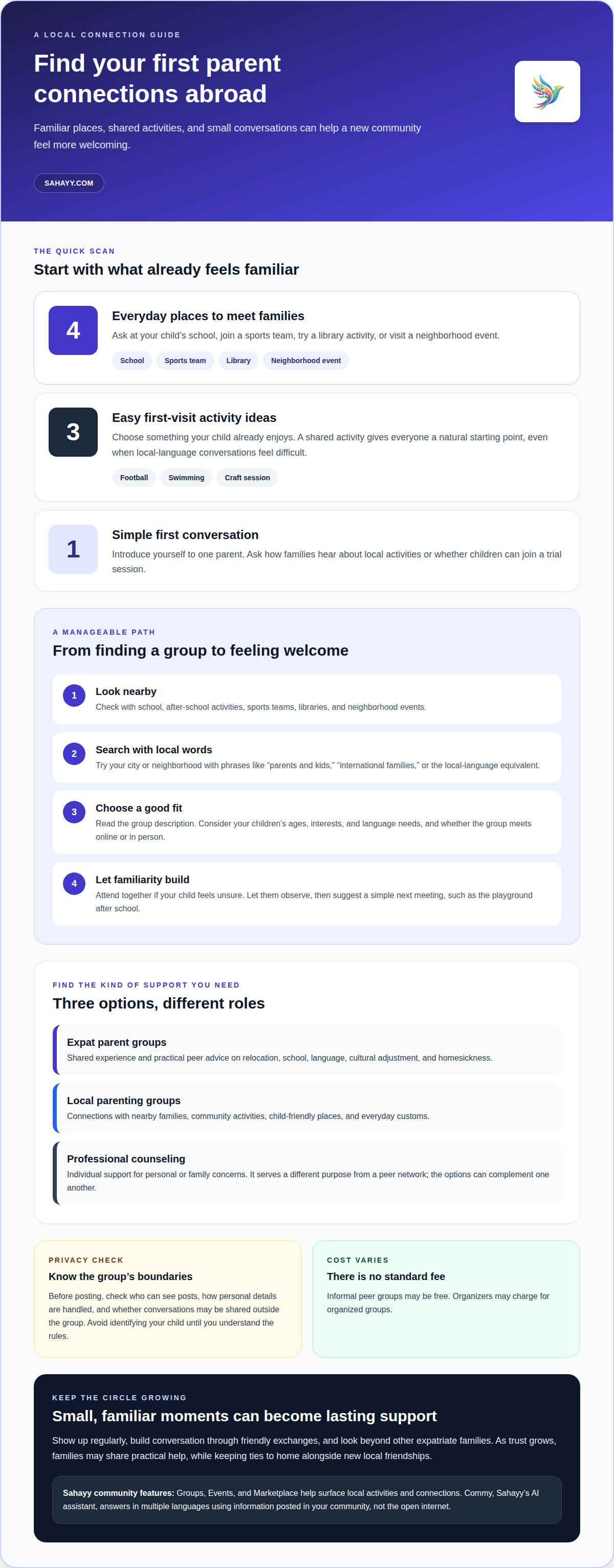
Expat parent groups offer shared experience and practical peer advice. Local parenting groups can help families connect with nearby residents and activities. Professional counseling serves a different purpose, providing individual support for personal or family concerns rather than a peer network. These options can complement one another, but they aren’t interchangeable.
Before joining an online group, read its privacy rules. Find out who can see posts, how personal details are handled, and whether members may share conversations outside the group. Avoid posting identifying information about your child until you understand the group’s boundaries.
There’s no standard fee for parent groups. Informal peer groups may be free, while organizers may charge for organized groups.
Common topics include relocation stress, choosing or settling into a school, language learning, cultural adjustment, homesickness, and keeping in touch with relatives back home. Parents can share specific strategies, such as asking a child what felt easy or difficult at school that day.
Start with one manageable step: explore ways to build a support network abroad, then look for a group that fits your family’s needs. Regular family activities and conversations about both home and host cultures can help children thrive.
2. Building a social network
Start with a regular point of contact, such as a weekly playgroup, school activity, or neighborhood gathering. Seeing the same parents regularly makes conversation easier and gives children familiar faces. Open with a simple question about the activity or local routines, then build the relationship through small, friendly exchanges. These moments can make daily life more comfortable as you navigate a new language and culture.
Look beyond other expatriate families, too. Local parents can share useful knowledge about community events, child-friendly places, and everyday customs. Joining a sports team or helping with a school activity gives parents and children a shared reason to meet people. Encourage children to spend time with local peers while respecting their pace and comfort. Familiar hobbies can bridge language gaps before everyone feels ready for longer conversations.
Connection can also mean mutual help. As trust grows, friends may be able to offer practical support, such as taking turns accompanying children to an activity. Agree on clear plans and boundaries so each family knows what to expect. In a parent group, offer help as well as asking for it. A small contribution can strengthen relationships and make the circle more welcoming.
Keep ties to home alongside new friendships. Finding people, familiar foods, or cultural gatherings from your home country can ease homesickness without limiting local connections. Parents might share a family tradition with neighbors, then join a community celebration in return. This balance supports children’s sense of belonging and gives adults more than one source of comfort. A stronger network can support mental wellbeing, practical needs, and the shared experience of raising children abroad.
3. How can expat parents find local meetups or parenting communities abroad?
Start with places your family already visits. Ask your child’s school about parent gatherings, family events, or groups connected with after-school activities. A sports team, library activity, or neighborhood event can also bring parents and children together around a shared interest. Familiar settings make it easier to start a conversation, even if you’re not fluent in the local language.
Search online using your city or neighborhood alongside phrases such as “parents and kids,” “international families,” or the local-language equivalent. Support groups for expat parents may meet in person or online, while local parent groups can introduce you to families nearby. Read the group description to understand its focus, then choose one that fits your children’s ages, interests, or language needs.
Make the first visit manageable. Choose an activity your child already enjoys, such as football, swimming, or a craft session, and introduce yourself to one parent. Ask how families hear about local activities or whether children can join a trial session. If your child feels unsure, attend together and let them observe before joining in.
After meeting someone, suggest a simple next step, such as meeting at a playground after school. A community marketplace can also help you discover local listings and family-related opportunities. Make plans specific, follow up warmly, and give new connections time to grow into friendships.
Sahayy
Sahayy helps parents abroad discover local communities, events, and useful connections in one place. Its mobile app brings together Groups, Events, and the Marketplace, making it easier to explore what’s happening nearby and find ways to participate. Looking for parent meetups? Use these community features to find relevant activities and connect with people who share your interests.
Commy, Sahayy’s AI assistant, answers queries in multiple languages using what’s actually posted in your community, not the open internet. Ask it about local groups or events as you find your way around. Sahayy is a practical next step when you’re ready to explore local connections, and it complements rather than replaces professional counseling when that’s what your family needs.
Explore Sahayy’s local groups and events to find community connections.
Make connection part of your next chapter
You don’t need to feel fully settled before reaching out. A new connection can begin with an honest conversation, a shared interest, or simply showing up when you feel ready.
As you explore support groups for expat parents, consider what would make a community feel welcoming to you. Perhaps you hope to exchange ideas, meet families with similar experiences, or find a place where your child can feel included. Let that intention guide your next step, and give relationships room to grow naturally.
Explore Sahayy to find local groups, events, and ways to build connections.
Each small act of connection can help make a new place feel more like home.
Frequently Asked Questions
What online support groups are available for expat parents?
Online options include parent-focused community groups, relocation forums, and local event platforms. Look for spaces that match your family’s current needs, such as settling into a school, raising bilingual children, or meeting parents nearby. Sahayy brings local groups and events together, so you can explore nearby communities and connect around shared interests.
Are there local support groups for expat parents in major U.S. cities?
Yes, parents can look for local meetups and parent communities in major U.S. cities, though available groups depend on the neighborhood and community. Check local school newsletters, library calendars, cultural associations, and family activity listings. Searching with a city or neighborhood name alongside “international parents” or “expat families” can help narrow the results.
Which organizations offer support groups for expatriate families and parents?
Support may come from local cultural associations, international schools, community organizations, and parent-led groups. Their purposes vary: one may organize family activities, while another focuses on relocation conversations or a shared language. Sahayy is a community platform for people living abroad, bringing local groups, events, services, and a marketplace together.
Are there support groups specifically for expat mothers, fathers, single parents, or LGBTQ+ parents?
Some parent communities are organized around a particular identity or family situation, while others welcome caregivers across backgrounds. Search group descriptions for terms that reflect what matters to you, such as single-parent families, LGBTQ+ inclusion, or fathers’ meetups. If the description is brief, review the group’s stated purpose and participation guidelines before sharing personal details.
How can parents join an expat support group, and what information is required?
Start by finding a group that fits your location, interests, and preferred format, then follow its joining steps. Requirements vary: a group may ask for a basic profile, your neighborhood, or a short note about why you’d like to join. Share only what’s needed to participate, and avoid posting sensitive details about yourself or your children publicly.

Article by
Vinay Patil
Vinay Patil is the founder of Sahayy, a community platform inspired by his own experience of moving to a new country and having to figure out things that someone already there could have answered in minutes. He believes that belonging is built through small acts of helping — sharing an event, answering a question, recommending a service, or simply connecting someone with the right people. With nearly two decades of experience in technology, Vinay is building Sahayy to make it easier for people to find trusted communities and feel at home, wherever they are in the world.
More at https://vinaypatil.com


