

Leaving home to study abroad is more than a housing search. A marketplace for international students leaving home can help make the practical transition easier by bringing accommodation options and local connections into view, while a welcoming community can make a new place feel less unfamiliar.
It’s natural to feel excited and unsettled at the same time. Time with family and friends, staying in touch after departure, and finding people who understand the move can all help you feel more grounded. This article explores how to approach the emotional side of leaving, what to look for in student accommodation listings, and how a community marketplace can help you take the next steps with more confidence.
Key Takeaways
- Plan what to sell, give away, or take with you before departure so you can focus on the belongings that matter most.
- Use local listings to connect with nearby buyers for furniture, electronics, and household items.
- Understand how a resale platform handles fees and payments before agreeing to a sale.
- Explore a community marketplace and local events to make practical connections as you prepare for a new place.
What are the best marketplaces for international students leaving the U.S. to sell or give away belongings?
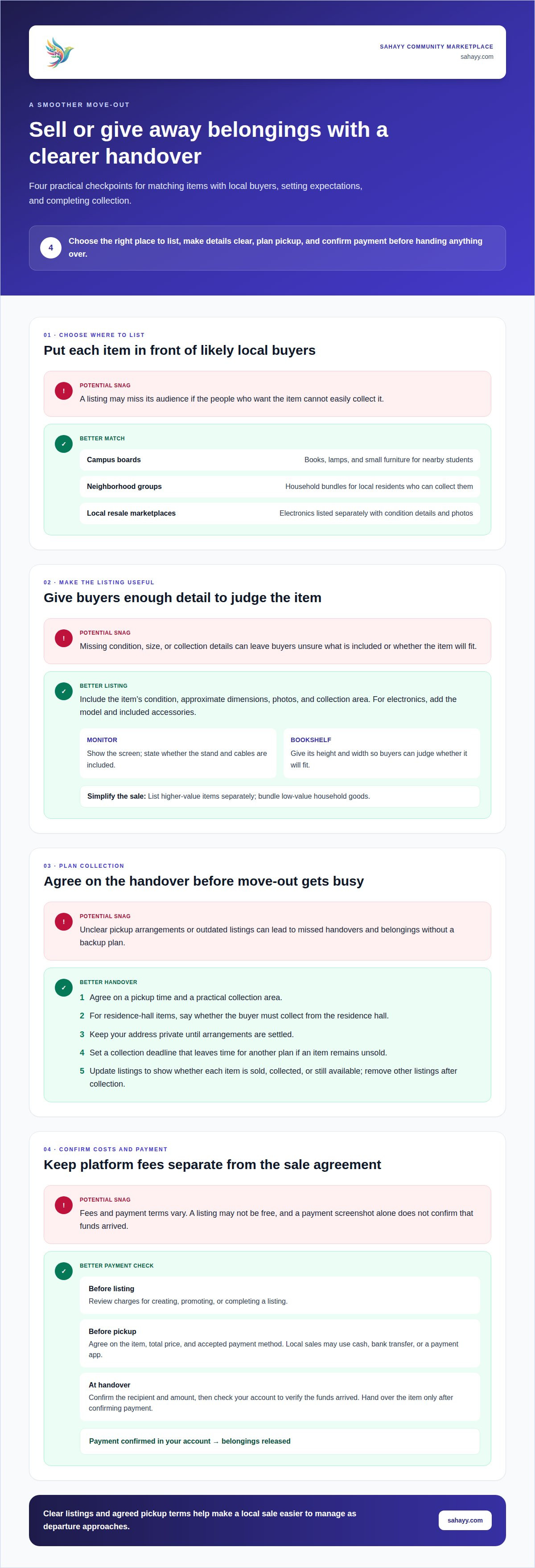
The best option depends on what you’re selling, when you’re leaving, and whether buyers can collect locally. A campus board or neighborhood group can connect you with nearby students looking for furniture or kitchenware. A broader local resale marketplace may suit smaller electronics. If you’re giving items away, a community group can help arrange collection. Compare the audience and listing options, then choose a place where likely buyers can pick up the items.
Make the handover straightforward. List higher-value items separately and bundle low-value household goods. Include the condition, approximate dimensions, and collection area. For a desk, say whether the buyer must collect it from a residence hall. Set a collection deadline that leaves time to make another plan for anything unsold.
- Campus boards: Post books, lamps, and small furniture for students nearby.
- Neighborhood groups: Offer household bundles to local residents who can collect them.
- Local resale marketplaces: List electronics separately, with clear condition details and photographs.
Keep health insurance terminology separate from resale listings. According to the Centers for Medicare & Medicaid Services, children under 14 with a pending application for asylum, withholding of deportation, or withholding of removal under immigration laws or the Convention against Torture may be eligible for Marketplace coverage. That Marketplace refers to health coverage, not a place to sell belongings.
Before you leave, update each listing to show whether the item is sold, collected, or still available. This helps avoid missed handovers and makes it clear which belongings still need a plan.
That distinction also matters for eligibility: the Centers for Medicare & Medicaid Services says that, in the United States, Deferred Action for Childhood Arrivals (DACA) recipients are not eligible for Marketplace coverage. The Centers for Medicare & Medicaid Services says some applicants for adjustment to lawful permanent resident status, Special Immigrant Juvenile Classification, or a Victim of Trafficking Visa may be eligible for Marketplace coverage.
Which platforms let international students sell furniture, electronics, and household items locally?
University classifieds, student housing groups, and local resale boards can connect you with nearby buyers. Campus-run boards reach people familiar with residence halls and student move-in needs, while neighborhood groups can reach residents beyond the university. Choose based on who is likely to want the item and how easily they can collect it.
Tailor the listing to the likely buyer. Students moving into shared housing may want a lamp, cookware, or a bookshelf. Local residents may be interested in a table or small appliance. Electronics can appeal to more people, so include the model, condition, and any accessories that come with the item.
- University classifieds: Post dorm essentials where students can find campus-related offers.
- Student housing groups: Share household items with people preparing to move into nearby accommodation.
- Neighborhood resale boards: List larger belongings for local collection beyond the campus community.
Use clear photos and include dimensions, condition, and a practical collection area. For a monitor, show the screen and say whether the stand and cables are included. For a bookshelf, give its height and width so buyers can judge whether it will fit. Agree on a pickup time, and keep your address private until the arrangements are settled.
If you post an item in more than one place, keep the details consistent and remove every listing after collection. That helps avoid duplicate messages during a busy move. To connect with local student life, explore nearby student connections.
Managing household tasks while studying abroad can be a useful part of learning to handle life in a new place. In the United States, people who are ineligible for Marketplace coverage may be able to access lower-cost care at community health centers, which provide primary care on a sliding fee scale based on income. Planning for your belongings alongside other practical needs can make a move feel more manageable.
What fees and payment methods do student resale marketplaces charge?
Costs depend on the platform and how you list an item. Different student resale platforms may have varying terms for local listings, paid promotion, and transactions. Don’t assume a listing is free or that every payment method works for every sale. Before posting, look for the platform’s fee details and check whether any charge applies to creating, promoting, or completing your listing.
Keep any platform charges separate from the payment arrangement. A resale site may have listing or transaction fees, and a payment service may have its own terms. For a direct sale, agree on the price and payment method before arranging pickup. If you’re selling kitchen items as a bundle, clarify whether the buyer takes everything or can choose individual pieces.
Local sales may involve cash, a bank transfer, or a payment app, depending on what both people can use. Confirm the recipient and amount for a transfer or app payment, and check your own account to verify that funds have arrived. A payment screenshot alone isn’t proof. Hand over the laptop, chair, or other item only after confirming payment.
- Before listing: Review the marketplace’s fee terms and note any optional promotion.
- Before pickup: Agree on the item, total amount, and accepted payment method.
- At handover: Confirm payment in the relevant account before releasing the belongings.
Clear terms help avoid confusion, especially when your departure date is close. Keep the agreed item and price in the platform conversation so you can refer back to them.
Sahayy: Community Marketplace
Sahayy brings local community connections and listings together in one place. Its Community Marketplace lets you post listings and share belongings with people nearby as you prepare to leave. The Sahayy Mobile App also includes Events, where you can discover and post local activities within the same community space.
For a move that feels both practical and emotional, Commy AI Assistant can answer queries in multiple languages. Use these tools to explore local listings and community activity as you prepare for life away from home.
Contact Sahayy if you’d like to learn more.
Make Your Next Move Feel More Connected
Your move can be a practical transition and a personal one. Take the next step by deciding what support would help most: a place to share belongings, local activities, or answers as you settle into unfamiliar surroundings.
A marketplace for international students leaving home can help with more than clearing a room. Sahayy’s Community Marketplace lets you share listings with local community members, while Events can help you find activities nearby. Commy answers queries in multiple languages using information posted in your community.
Choose one manageable action today, such as organizing the belongings you’ll sell or looking for a welcoming local gathering. Small steps can make a new place feel more familiar while you prepare to leave home.
Your next chapter can begin with a practical plan and a stronger sense of connection.

Article by
Vinay Patil
Vinay Patil is the founder of Sahayy, a community platform inspired by his own experience of moving to a new country and having to figure out things that someone already there could have answered in minutes. He believes that belonging is built through small acts of helping — sharing an event, answering a question, recommending a service, or simply connecting someone with the right people. With nearly two decades of experience in technology, Vinay is building Sahayy to make it easier for people to find trusted communities and feel at home, wherever they are in the world.
More at https://vinaypatil.com


