

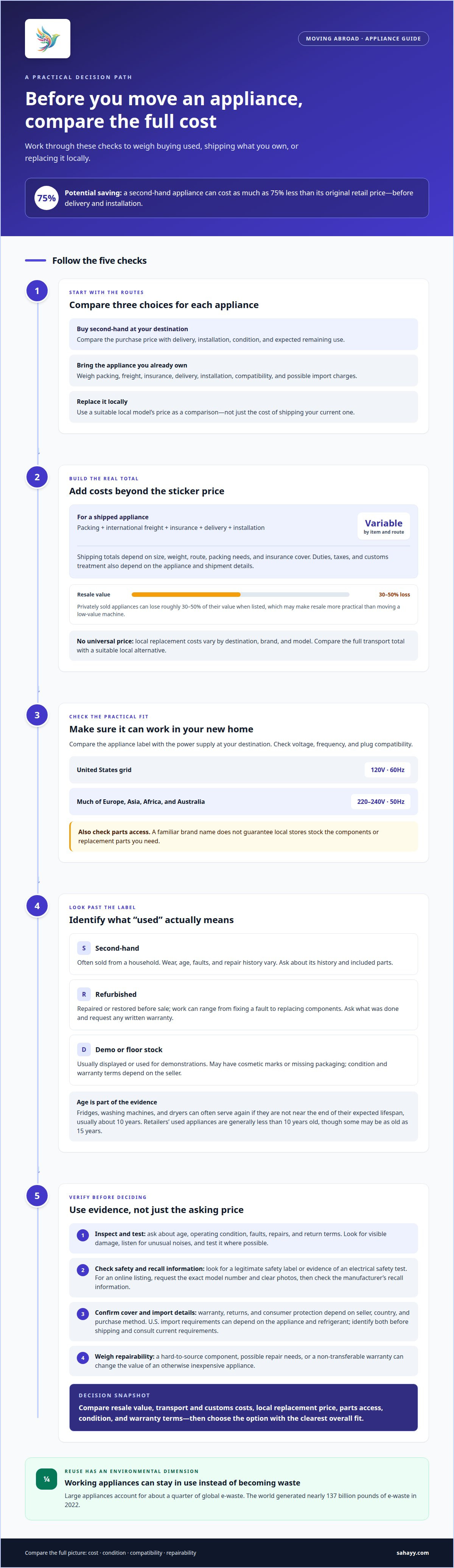
The lowest-priced appliance abroad may not be the cheapest choice once you factor in getting it there. Buying second-hand appliances abroad can cost as much as 75 percent less than the original retail price, before delivery and installation, while bringing an appliance means weighing transport and practical fit against the cost of replacing it locally.
It’s understandable to want familiar appliances in a new home, especially when moving already brings plenty of decisions. This guide explains when buying second-hand appliances abroad may make sense, how the costs of buying, bringing, or replacing appliances compare, and what distinguishes second-hand, refurbished, demo, and floor-stock models. You’ll have a clearer way to weigh the trade-offs and choose an option that suits your move.
Key Takeaways
- Compare the full cost of buying locally, shipping what you own, and replacing appliances after the move.
- Consider an appliance’s age, condition, and practical fit before deciding whether a used option is worthwhile.
- Learn how refurbished, second-hand, demo, and floor-stock appliances differ so you can choose with greater confidence.
- Use Sahayy’s Community Marketplace and local community features to connect with people and listings in your new home.
1. Why buy second-hand appliances?
A used washing machine or kitchen appliance can cost as much as 75 percent less than its original retail price, before delivery and installation. Reusing working appliances also helps the environment: large appliances account for about a quarter of global e-waste, and the world generated nearly 137 billion pounds of e-waste in 2022.
The savings come with trade-offs. Fridges, washing machines, and dryers can often serve again if they aren’t near the end of their expected lifespan, usually about 10 years. Ask about the machine’s age, operating condition, and any repair history. Inspect visible damage, listen for unusual noises, and look for a legitimate safety label or evidence of an electrical safety test.
Warranty, return terms, and consumer protection depend on the seller, country, and purchase method. In Australia, sellers operate under Australian consumer law, while buyers purchasing from an overseas website may not have the same level of protection. Separately, the European Union codifies Transfer of Residence relief in Council Regulation (EC) No. 1186/2009.
For used appliances or refrigerants brought into the United States, import requirements can depend on the appliance and refrigerant. Identify the model and refrigerant before shipping, then consult current U.S. import requirements for that item.
For a safer purchase abroad, choose a seller who allows testing and explains the appliance’s condition and return terms. A local newcomer community can also share neighborhood recommendations; building a support network abroad can make those local connections easier. Before buying, compare the appliance’s label with your home’s power: the U.S. grid operates at 120V and 60Hz, while much of Europe, Asia, Africa, and Australia uses 220-240V and 50Hz. Check voltage, frequency, and plug compatibility.
2. Comparing the costs of replacing versus bringing appliances
Compare the full cost of keeping, shipping, or replacing each appliance. Privately sold appliances can lose roughly 30-50% of their value when listed, which may make resale more practical than paying to move a low-value machine. Before buying second-hand appliances abroad, add packing, international freight, insurance, delivery, and installation costs to the purchase price. Shipping totals depend on the appliance’s size, weight, route, packing needs, and insurance cover.
For U.S. imports, duties, taxes, and customs treatment depend on the appliance and shipment details. There is no single flat amount for every used fridge, washing machine, or dryer. Include potential charges in your comparison rather than treating the purchase price as the final cost.
Local replacement costs also vary by destination, brand, and model. Compare a suitable local appliance with the total transport cost, then consider whether compatible components and replacement parts are available where you’re going. A familiar brand name doesn’t guarantee local stores stock the parts you need.
When buying second-hand appliances abroad, consider any remaining warranty or guarantee and whether it transfers to a new owner or country. A recalled appliance can raise safety concerns, while a hard-to-source component can make an inexpensive purchase costly to maintain. For a fridge or dryer, weigh likely repair needs against replacement options.
Make a simple list for each item: resale value, transport and customs costs, local replacement price, parts access, and warranty terms. Local newcomer connections can also help you learn which stores and repair options are nearby; connect with your new community as you settle in.
There is no universal price; the total depends on the appliance, route, packing requirements, and insurance cover.
3. Refurbished appliances compared with second-hand, demo and floor-stock models
“Used” describes a history, not a single condition. A second-hand dishwasher may come directly from a household, with wear and repair history that varies. Retailers’ used appliances are generally less than 10 years old, though some may be as old as 15 years. Ask the seller about the appliance’s age, faults, repairs, and included parts.
Refurbished appliances have been repaired or restored before sale. The work can range from fixing a fault to replacing components, so the label alone doesn’t explain what was done. Ask for repair details and any written warranty. Compare this information with the model’s age and expected lifespan, rather than treating “refurbished” as a guarantee of like-new condition.
Demo and floor-stock models have usually been displayed or used for demonstrations. They may have cosmetic marks or missing packaging, but may have seen less household use than a second-hand machine. Their condition and warranty terms depend on the seller. Inspect the appliance, accessories, and documentation before choosing.
For online listings, request the model number and clear photos. Test the machine where possible, listen for unusual sounds, and look for damage. Search the manufacturer’s recall information using the exact model number. A recalled appliance presents a different risk from a cosmetic mark, and repairability matters if replacement parts are scarce.
Choose based on evidence: repair records for refurbished models, usage and condition for second-hand goods, and display wear for demo stock. Whatever the label, compare the appliance itself, included components, and warranty terms before paying.
Sahayy
Sahayy helps people living abroad connect with local communities as they settle into a new home. If you’re weighing a used appliance purchase, local connections can help you learn about neighborhood options and share practical experiences. The Community Marketplace brings community listings together, while Event Discovery and Posting can help you find ways to meet people nearby. The Sahayy Mobile App and Commy AI Assistant offer additional ways to engage with the platform.
Use these community tools to feel more connected as you make everyday decisions in a new country. For questions about Sahayy, contact Sahayy.
Make your new place feel like home
A move abroad is also a chance to shape new routines around the place you’re joining. As you weigh buying second-hand appliances abroad, think beyond the appliance itself: local knowledge can help you feel more grounded as you settle in. A neighbor’s practical tip or a familiar face can make everyday choices feel easier.
Sahayy brings people living abroad closer to local communities. Turn to it as you look for ways to connect and feel more at home in your new surroundings. Finding your people takes time, but small connections can make a new place feel more welcoming.
Take the next step at your own pace. A new home becomes more familiar one connection at a time.
Frequently Asked Questions
Why buy second-hand appliances?
Buying used can help you furnish a home while keeping working appliances in use. It can be especially useful when you need a basic machine temporarily or are still learning what fits your household’s routines. For example, someone moving into a furnished rental later might choose a used kettle or washing machine rather than buying new immediately. Compare convenience, condition, and expected remaining use, not just the sticker price.
What is a refurbished appliance?
A refurbished appliance is a previously owned or returned item that has been repaired or restored before resale. The term doesn’t describe one fixed standard: one seller might replace a faulty component, while another might clean and inspect the appliance. Ask for a written description of the work, which parts were replaced, and what warranty terms apply. This gives you a clearer basis for comparing it with an ordinary used model.
What should I check before buying a second-hand appliance abroad?
Start with the exact model number, manufacture date if available, dimensions, and the space where the appliance will go. For a built-in oven, for example, measure the cabinet opening and confirm the connection type matches your home. Review the seller’s return terms and any warranty in writing. Also check whether the manual and controls are understandable to you, especially if the model differs from those you’ve used before.
How can I verify an appliance's condition and test it before purchase?
Arrange a test while the appliance is connected and operating normally. Run a washing machine through a cycle and watch for leaks, unusual movement, or error messages. For a fridge, check that it starts, runs, and maintains a steady temperature after installation. Inspect cords, doors, seals, and visible surfaces. Record the model and any faults in writing so the item’s stated condition is clear before payment.
What are the risks of buying used appliances abroad, including scams and hidden defects?
Risks include inaccurate listings, concealed faults, missing parts, and limited options if a private seller won’t accept a return. A photo alone can’t show whether a dishwasher drains properly or a fridge cools reliably. Avoid paying before matching the appliance to the listing and seeing it operate. Keep the seller’s messages and transaction details, and use a payment method with clear records. Walk away if details change or testing is refused.

Article by
Vinay Patil
Vinay Patil is the founder of Sahayy, a community platform inspired by his own experience of moving to a new country and having to figure out things that someone already there could have answered in minutes. He believes that belonging is built through small acts of helping — sharing an event, answering a question, recommending a service, or simply connecting someone with the right people. With nearly two decades of experience in technology, Vinay is building Sahayy to make it easier for people to find trusted communities and feel at home, wherever they are in the world.
More at https://vinaypatil.com


