

The date line is one of the easiest parts of a formal French letter to understand: it gives the town, a standard date marker, then the day, month, and year. Decoding official letters in French starts with recognizing these conventions, which help make a message clear and appropriately formal.
It’s understandable to pause over the details, especially when the salutation and closing seem to follow unfamiliar rules. This guide shows you how to format the date, arrange a formal letter, and choose a closing that suits your relationship with the recipient. You’ll also learn which forms of address work in administrative and professional correspondence, so you can write with more confidence.
Key Takeaways
- Format the date with the town first, then “le” and the day, month, and year.
- Match your closing to the recipient and the level of formality in your relationship.
- Arrange a paper letter so the sender and recipient details, message, and signature are easy to follow.
- Use respectful administrative forms of address and keep your wording consistently formal.
Choosing a French letter closing based on the relationship
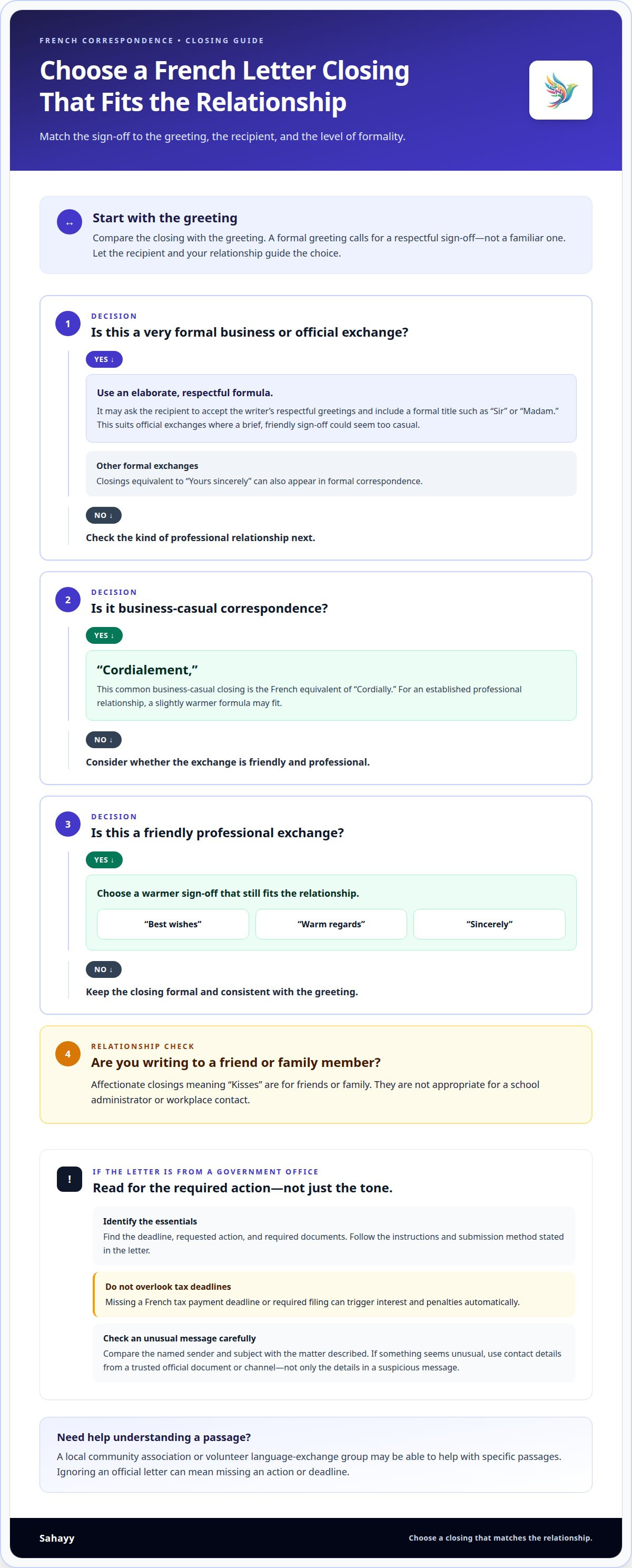
- Compare the closing with the greeting and consider who the letter is addressing. A formal greeting is generally followed by a respectful sign-off, not a familiar one. In French correspondence, the closing reflects the relationship with the recipient.
- A very formal business letter may use an elaborate closing formula. These usually ask the recipient to accept the writer’s respectful greetings and include a formal title such as “Sir” or “Madam.” They suit official exchanges where a brief, friendly sign-off might seem too casual.
- “Cordialement,” the French equivalent of “Cordially,” is common in business-casual correspondence. A slightly warmer formula may suit an established professional relationship. Other closings equivalent to “Yours sincerely” can appear in formal exchanges, while familiar sign-offs are generally reserved for people who know each other well.
- In a friendly professional exchange, a sign-off meaning “Best wishes,” “Warm regards,” or “Sincerely” can reflect the relationship. Affectionate closings meaning “Kisses” are for friends or family, not a school administrator or workplace contact. The sign-off should match the message’s tone.
- When reading a government letter, identify the deadline, requested action, and required documents. Follow the instructions and submission method given in the letter. Missing a French tax payment deadline or required filing can trigger interest and penalties automatically.
- To assess whether a letter is authentic, compare the named sender and subject with the matter described. If anything seems unusual, use contact details from a trusted official document or channel rather than relying only on information in a suspicious message.
- For free language support, look for a local community association or volunteer language-exchange group and ask for help understanding specific passages. Ignoring an official letter can mean missing an action or deadline. For tax matters, late payment or filing can bring automatic interest and penalties.
Formal French letter structure and layout
Read a French letter from the sender details through to the requested action, then consider how its wording signals purpose and tone. Each part, from the subject line to the sign-off, helps you understand the message.
-
Check Formality, Grammar, and Abbreviations
First identify whether you have a paper letter or an email. A paper letter typically places the sender’s address at the top left and the recipient’s at the top right. Formal emails usually omit these address blocks and the place-and-date line. In either format, look for an attachment label to see whether supporting documents are included.
Look for formal grammar: the writer uses the formal second-person pronoun and keeps the written negative form intact. Formal correspondence avoids contractions and abbreviations. Connectors meaning “however” or “therefore” show how ideas relate. These details make decoding official letters in French easier by revealing how the message is organized.
-
Identify Wording, Register, and Salutations
Identify the sender’s name, organization, and subject line before interpreting the main message. The subject points to the issue, while the opening paragraph usually explains the letter’s purpose, such as requesting information or responding to earlier correspondence.
In a first formal contact, expect a suitable title rather than a greeting that simply means “Dear.” A professional greeting to someone known may use their first name, while a title identifying a female department head signals the recipient’s role. The relationship matters: a school or administrative office calls for a more formal register.
-
Interpret Greetings and Polite Expressions
Read the greeting, request, and ending together. A phrase meaning “I kindly ask you to” introduces a polite request, while “I would like to” sounds more courteous than “I want.” These cues help show whether the writer is asking, informing, or seeking a response.
Compare the closing with the greeting to understand the intended level of formality. In a template, the greeting, body, closing, and signature each have a separate place; a formal letter’s signature usually appears on the right. Formal emails can use the same greeting and closing conventions with a shorter body. This context helps with decoding official letters in French without treating each phrase in isolation.
Administrative forms and forms of address
- Use “Madame” for a woman in formal correspondence, whether she is married or unmarried. In 2012, the French government asked administrations to stop using “Mademoiselle” on forms and in letters. Avoid adding a surname after “Monsieur” or “Madame” when addressing someone formally; use “Madame,” or “Monsieur,” as the salutation.
- Look for a professional title when the recipient’s role is known. A department head may be addressed as “Madame la Directrice,” or “Monsieur le Directeur,” and a lawyer or notary as “Maître,”. “Docteur,” is used for a doctor. These titles create a clear, respectful form of address without using a first name.
- A formal letter uses “vous” throughout, even when it is addressed to one person. Verbs and requests remain consistent with this respectful register: “Je souhaiterais” is more polite than “je voudrais,” while “Je vous prie de bien vouloir” introduces a courteous request. Informal wording more common among friends and family is generally avoided.
- Read administrative fields carefully before entering personal details. French forms use “nom de famille” for family name and “nom d’usage” for a name used in addition or instead. These terms replace “nom patronymique,” “nom d’épouse,” and “nom d’époux.” For a foreign applicant, following the field labels helps place each name correctly.
- “À qui de droit” is used when a document has no named recipient, such as a reference letter or certificate. In a formal letter, “mes salutations” belongs in a closing formula, not the greeting. Warmer forms of address and sign-offs are generally for friends and family, where the relationship makes them appropriate.
Sahayy
Sahayy helps people living abroad build local connections after handling practical tasks such as French correspondence. The Sahayy Mobile App brings local events, groups, services, and a marketplace together, helping you discover community activity and take part. Event Discovery and Posting lets users find or share gatherings, while the Community Marketplace supports local listings. Commy AI Assistant answers queries in multiple languages, offering a place to raise everyday questions as you settle into a new environment. These tools complement, rather than replace, careful reading of official notices. They can help you connect with people and local resources beyond the paperwork.
Contact Sahayy to learn more or share what you’re looking for.
Make French correspondence easier to manage
Turn each new letter into a useful personal reference. Keep a private note of administrative terms you’ve learned, the type of document where they appeared, and any questions you want to clarify. Over time, this can make decoding official letters in French feel less like starting from scratch and help you approach future correspondence with a clearer plan.
Connections around you can also be part of settling into life abroad. Local conversations and shared experiences can help you feel more at home while you handle everyday tasks, including unfamiliar paperwork. Take the next step at a pace that feels comfortable.
Each new connection can make an unfamiliar place feel more welcoming.
Frequently Asked Questions
How do you write the date in a French letter?
Write the day before the month, then the year, without a comma between them. For the first day of a month, use “1er,” as in “Paris, le 1er juin 2026.” In a formal letter, the town comes first, followed by a comma and “le.” Keep the month name lowercase, including in dates such as “Paris, le 14 mai 2026.”
What does “Cordialement” mean?
“Cordialement” means “Cordially” and is a semi-formal sign-off for business-casual correspondence. It suits a routine professional email, such as a brief reply to a colleague or service contact. It’s less elaborate than a very formal closing formula, so it fits an exchange that is professional but doesn’t call for a highly formal tone.
What are common French administrative abbreviations and acronyms in official letters?
“PJ” or “pj” abbreviates “pièce(s) jointe(s),” meaning an enclosure or attachment. “Recommandé A/R” refers to registered mail with a return receipt. These clues can help you identify an attachment or the delivery method mentioned in a letter. Read the surrounding sentence too, since the abbreviation alone won’t tell you what action the sender expects.
How do you translate common legal and administrative terms in French letters?
Interpret administrative terms in context rather than relying on a word-for-word translation. For example, “À qui de droit” means “To Whom it May Concern” and appears in documents such as reference letters, recommendations, and certificates. The labels around a form field matter too: “nom de famille” identifies a family name, while “nom d’usage” refers to a name used in addition or instead.
What do common French tax, immigration, and benefits letters mean?
A French tax letter may be a routine notice or bill, such as an “Avis d’Impôt,” or a specific enquiry requesting documents or clarification. A manual enquiry concerns a particular issue and doesn’t necessarily mean a formal audit. For immigration or benefits correspondence, identify the subject, requested action, deadline, and listed documents to understand what response the letter calls for.

Article by
Vinay Patil
Vinay Patil is the founder of Sahayy, a community platform inspired by his own experience of moving to a new country and having to figure out things that someone already there could have answered in minutes. He believes that belonging is built through small acts of helping — sharing an event, answering a question, recommending a service, or simply connecting someone with the right people. With nearly two decades of experience in technology, Vinay is building Sahayy to make it easier for people to find trusted communities and feel at home, wherever they are in the world.
More at https://vinaypatil.com


