

A welcoming community often starts with a small local invitation. Community events for families abroad can include church gatherings, parent and expat groups, cultural activities, and projects where children learn alongside local families. Contact people before you arrive when possible, share your children’s ages and how long you’ll stay, and ask what activities suit them.
It’s natural to want your children to make friends and feel confident about where they’ll spend their time. The right local connection can help with both. This guide explains how to find families and community groups, what to ask about age suitability and adult supervision, and how to explore local events and activities. You’ll also learn how to approach organizers, discuss a welcome contribution, and give new connections room to grow.
Key Takeaways
- Reach out to churches, parent groups, and community organizers with a short introduction about your family and how long you’ll be staying.
- Before joining an activity, clarify age suitability, adult supervision, and what children will be doing.
- Invite local families to share a skill or activity, and discuss a suitable contribution for their time and help.
- Explore neighborhood events and groups to find shared interests, then make another plan to help new connections grow.
Finding local families through churches and community groups
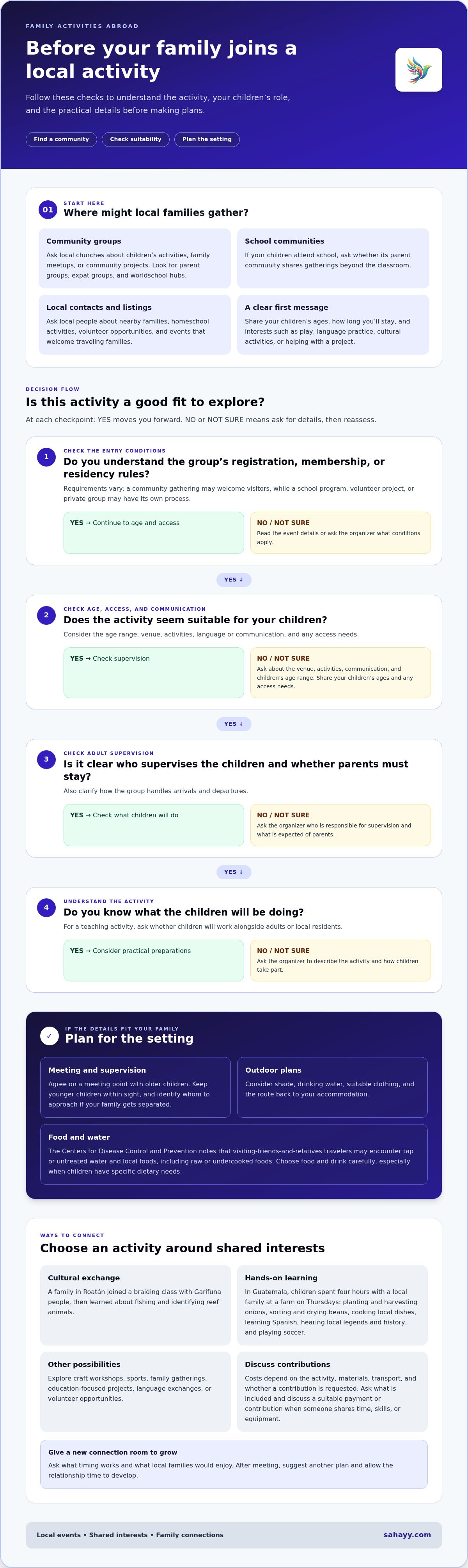
Start where families already gather. Ask local churches about children’s activities, family meetups, or community projects. Look for parent groups, expat groups, and worldschool hubs in your destination. If your children attend school, ask whether its parent community shares information about gatherings beyond the classroom. These networks can point you to activities led by families who live nearby.
Make your first message specific. Before arrival, when possible, share your children’s ages, how long you’ll stay, and what kind of connection you’re seeking. Mention interests such as play, language practice, cultural activities, or helping with a project. A support network abroad often begins with a clear, friendly introduction.
When contacting a community project organizer, ask what help would be useful and explain how long your family will be around. If someone offers their time or skills, discuss what payment or contribution they would welcome. This recognizes their effort and sets clear expectations. To get a closer view of everyday life, consider staying beyond the main tourist town, where local gatherings may be easier to reach.
In Guatemala, one family’s children spent four hours with a local family at a farm on Thursdays. They planted and harvested onions, sorted and dried beans, cooked local dishes, learned Spanish, heard local legends and history, and played soccer. This example shows how a local connection can bring learning and shared activity together. After meeting families, suggest another plan, then give the relationship time to grow.
Age requirements and parental supervision
Registration, membership, and residency rules vary by organizer and activity. Community gatherings may welcome visitors, while a school program, volunteer project, or private group may have its own entry process. Read the event details to understand the conditions that apply.
To assess accessibility, language, and age suitability, review the event description and ask the organizer about the venue, activities, communication, and children’s age range. Share your children’s ages and any access needs so the organizer can provide relevant details.
Before attending, clarify who supervises children, whether parents must stay, and how the group handles arrivals and departures. For a teaching activity, ask what children will do and whether they’ll work alongside adults or local residents. These details help you decide whether the experience suits your family.
Plan for the setting as well as the schedule. Agree on a meeting point with older children, keep younger children within sight, and identify whom to approach if your family gets separated. For outdoor events, consider shade, drinking water, suitable clothing, and the route back to your accommodation.
Pay attention to food and water during family activities. The Centers for Disease Control and Prevention notes that visiting-friends-and-relatives travelers may encounter tap or untreated water and local foods, including raw or undercooked foods. Choose what your family eats and drinks with care, especially if children have specific dietary needs.
For easier planning, explore local event listings and compare the activity details with your children’s needs before making plans.
Local events and activities
Family activities abroad can bring together cultural learning, shared interests, and everyday community life. Choose opportunities that suit your children’s interests and your family’s schedule.
Types of Local Activities
Look for cultural exchanges, craft workshops, sports, family gatherings, and education-focused projects. In Roatán, one family joined a braiding class with Garifuna people, then learned about fishing and identifying reef animals. Ask local contacts which activities families enjoy, what timing works, and whether members would like to share a skill. These conversations can lead to meaningful experiences with local residents.
Event Costs
There isn’t one typical cost for family events abroad. The amount depends on the activity, materials, transport, and whether an organizer requests a contribution. A community gathering may involve different expenses from a guided class or boat outing. Before agreeing, ask what’s included and discuss a welcome payment or contribution when someone shares time, skills, or equipment.
International and Online Gatherings
Yes, international programs can connect families across countries, and online gatherings offer another way to meet. The Alliance Française of San Diego partners with MyFamilyAbroad on a cultural exchange program connecting families in France and the United States. Local culture also shapes activities: a Garifuna-led braiding class in Roatán offers a different experience from a language exchange or school-based project. Look for formats that welcome traveling families and suit your children’s interests.
Ask local people whether they’d be interested in sharing a skill or activity with children. Local contacts may also know about families nearby, homeschool activities, volunteer opportunities, or someone willing to teach children. When inviting people to gather, ask what timing works and what they’d enjoy.
Sahayy: Sahayy Mobile App
Sahayy brings local events, groups, services, and a community marketplace together in one mobile app for people living abroad. If you’re looking for family activities after exploring local options, Event Discovery and Posting helps you find or share community events. The Community Marketplace gives users a place to post listings, while Commy AI Assistant can answer queries in multiple languages.
Use these tools to discover nearby connections and activities that suit your family’s interests. Event details can help you decide what to explore, while Commy offers another way to ask questions about what’s posted in your community. The app supports local discovery, and event details help families choose activities that suit their children.
Visit sahayy.com to explore Sahayy, or contact the team with your questions.
Make your next local connection
A sense of belonging can begin with one shared activity. Let your children’s curiosity guide the next step, whether that means joining a cultural gathering, meeting another family, or discovering a new interest together. Keep plans flexible, and let familiar faces turn into lasting connections over time.
For families looking for community events for families abroad, the next step is finding an easy way to discover what’s happening nearby. Sahayy’s Mobile App brings Event Discovery and Posting together with the Commy AI Assistant, helping families explore local community connections.
Your family’s next meaningful connection could start with a local invitation.
Frequently Asked Questions
What kinds of community events are available for families living abroad?
Families can join parent-child language exchanges, shared meals, sports sessions, craft workshops, holiday gatherings, or volunteer projects. Choose activities where children can participate, not just watch. A hands-on workshop, for example, lets siblings with different interests contribute at their own pace. Ask whether adults and children take part together and whether families can attend once before joining a recurring group.
Where can families abroad find local community events and activities?
To find community events for families abroad, search using a city or neighborhood name and a specific interest, such as children’s music or weekend crafts. Try the local-language version of those terms, too. Check municipal culture calendars, library noticeboards, school newsletters, and community pages, then compare the location, event format, and organizer details before choosing.
How can expatriate families find events in their city or region?
Start with places your family can comfortably reach, then search for an activity your children enjoy in each area. For a wider regional search, include nearby towns or districts. Save useful organizer pages and add promising dates to a shared family calendar. This makes it easier to spot schedule clashes and revisit events that suit everyone.
What family-friendly events are commonly hosted by expat communities, schools, and cultural organizations?
Expat groups, schools, and cultural organizations may host family meetups, student gatherings, cultural celebrations, and activities based on shared interests. For example, KAHAL microgrants may fund a one-off event bringing Jewish students together in their study-abroad destination. Families can also look for school arts events or community-led cultural activities, choosing gatherings where children have a clear way to participate.

Article by
Vinay Patil
Vinay Patil is the founder of Sahayy, a community platform inspired by his own experience of moving to a new country and having to figure out things that someone already there could have answered in minutes. He believes that belonging is built through small acts of helping — sharing an event, answering a question, recommending a service, or simply connecting someone with the right people. With nearly two decades of experience in technology, Vinay is building Sahayy to make it easier for people to find trusted communities and feel at home, wherever they are in the world.
More at https://vinaypatil.com


