

A child can belong to more than one culture and still feel unsettled by a move. A third-culture kid spends a significant part of their first 18 years accompanying a parent to a country different from at least one parent’s passport countries for the parent’s work or advanced training. Support for raising third-culture kids starts with listening to how each child experiences that journey.
Transitions can bring loss and uncertainty, but growing up across cultures can also foster curiosity, adaptability, and connection. This article explores how those changes may affect children, how parents can help them feel understood, and how schools and local community groups can nurture belonging. You’ll also find practical ways to honor cultural roots while making room for each child’s evolving identity.
Key Takeaways
- Make space for your child’s identity to include more than one culture, and listen before assuming what a transition feels like for them.
- Help children explore the strengths they gain from cross-cultural experiences while making room for grief and change.
- Look to international schools and local groups for shared interests and connections that can help children feel they belong.
- Use Sahayy to discover nearby events, communities, and marketplace listings as your family builds local connections.
1. What Does Transition Look Like for Third-Culture Kids?
A third-culture kid spends a significant part of their first 18 years accompanying a parent to a country different from at least one parent’s passport country for work or advanced training. Moving between countries can shape identity through the mix of a family’s culture and each new place. For missionary children, faith and community may be central, but neither label has to define a child’s whole story.
Help your child shape a personal identity narrative by talking about the places, languages, traditions, and relationships that matter to them. Ask what they want to carry forward from a previous home and what they enjoy discovering in their current one. Share your own cultural experiences, too, while staying curious about how siblings may see things differently.
To support identity and belonging, talk openly about culture and listen to how your child describes themselves. Keep family traditions in everyday life, stay connected with extended family, and let each child choose which customs feel meaningful. A familiar meal, a grandparent’s story, or a celebration at home can all help a child feel rooted.
Friendships can continue across countries through voice notes, shared photos, or calls planned around time zones. Invite children to choose how they want to stay in touch, and use this guide to build a support network abroad for ideas on connection during a move.
Counseling and support-program costs vary by format, location, and service. Whether insurance covers care, and what a family pays out of pocket, depends on the plan’s benefits and eligibility.
2. Benefits of growing up across cultures
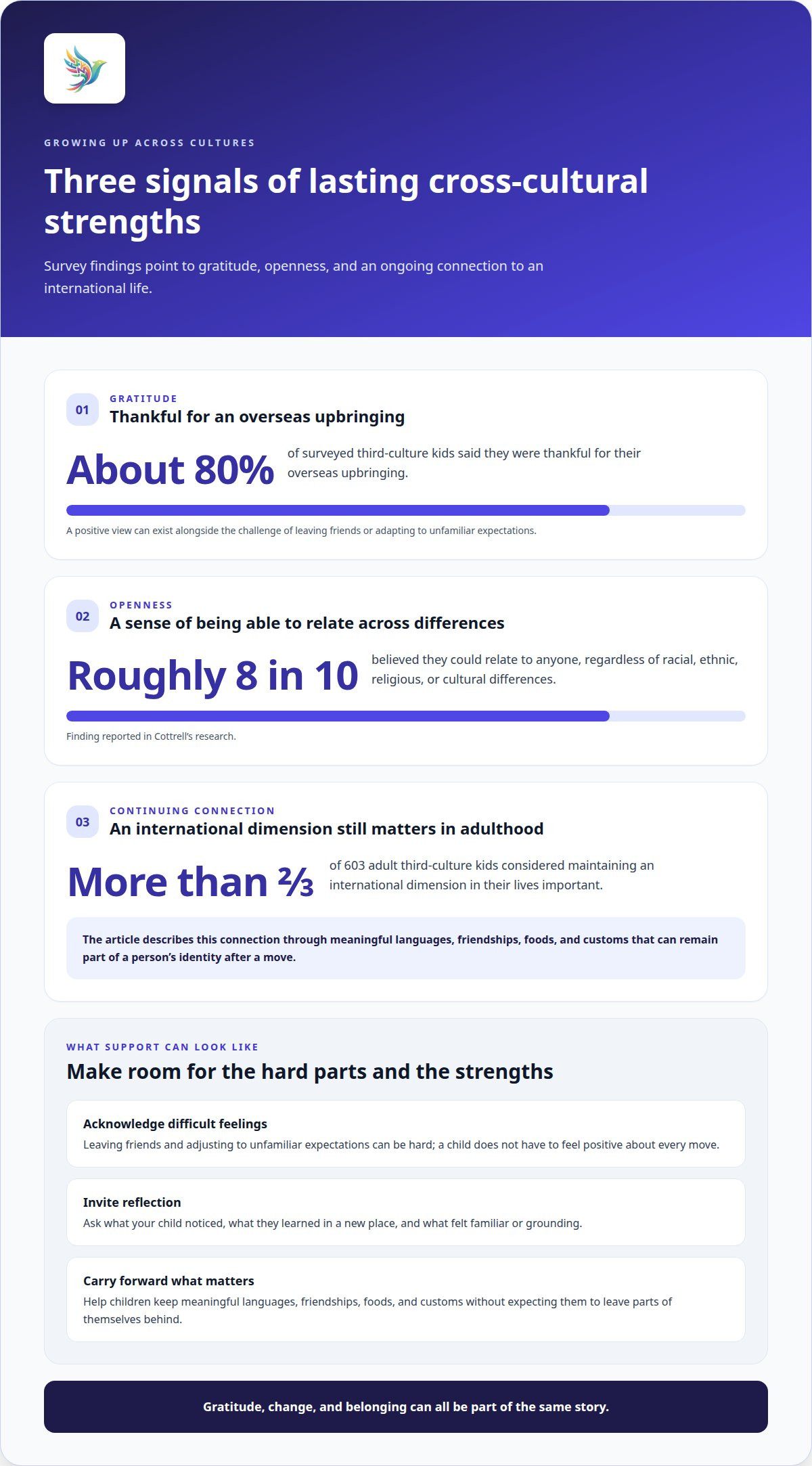
About 80% of surveyed third-culture kids said they were thankful for their overseas upbringing. Gratitude can exist alongside challenges, such as leaving friends or adapting to unfamiliar expectations. Children don’t need to feel positive about every move for their experiences to become meaningful. Support for raising third-culture kids includes acknowledging difficult feelings while inviting children to name what they’ve learned in each place.
Growing up across cultures can help children recognize that people communicate, celebrate, and solve problems in different ways. Cottrell’s research found that roughly eight out of ten third-culture kids believed they could relate to anyone, regardless of racial, ethnic, religious, or cultural differences. Parents can nurture that openness with everyday questions: What did your child notice about a classmate’s tradition? What did they have in common?
A survey of 603 adult third-culture kids found that more than two-thirds considered maintaining an international dimension in their lives important. An overseas upbringing may remain part of a person’s identity long after a move. For parents raising third-culture kids, support can include helping them carry forward meaningful languages, friendships, foods, and customs.
Turn these strengths into everyday habits. After a school change, invite your child to share a new perspective they encountered and something familiar that helped them feel grounded. If a cultural misunderstanding arises, talk about what each person may have meant instead of treating difference as a problem. These conversations link curiosity with empathy and help children adapt without feeling they must leave parts of themselves behind.
3. International schools and local community groups
An international school can give a child regular contact with peers from different cultures. Shared experiences may make it easier to talk about changing countries, languages, and routines without having to explain every detail. Ask which classmates or school activities help your child feel included, then look for ways to maintain those connections outside class.
School communities differ, so focus on everyday opportunities to join clubs, work with classmates, and take part in cultural activities. A child who enjoys music, for instance, might connect through a school performance, while a sports team can provide a familiar routine after a move. Shared activities help friendships grow around common interests, not just an international background.
Outside school, local expat clubs, cultural associations, and sports groups can help widen a child’s social circle. Choose an activity that suits your child’s interests and comfort, such as a weekend football group or a cultural celebration. Attend together at first if that helps, then let your child decide whether to return or try something else.
Make community-building more manageable with a simple plan: ask your child what they would like to try, find a local group, and talk afterward about how the first visit felt. A familiar weekly activity can add structure in a new country, while connecting with peers who share similar experiences may help your child feel understood. Focus on building connections, not on finding a perfect fit every time.
Sahayy: Sahayy Mobile App
Sahayy helps families explore community connections as they settle into a new place. With the Sahayy Mobile App, families can discover local events and groups, share listings, and browse the Community Marketplace. Event Discovery and Posting makes it easier to find activities suited to a child’s interests, from sports to cultural gatherings.
If you’re not sure where to begin, Commy, Sahayy’s AI assistant, can answer queries in multiple languages based on what’s posted in the community. Use it to discover nearby events and groups, then let your child choose which activities feel comfortable. These local connections can complement the routines and relationships your family builds at home and school.
If you’d like to explore these community options, visit Sahayy online.
Keep building belonging, one connection at a time
A child’s sense of home can shift as relationships and surroundings change. Let your next step reflect what your child says they need now: a familiar routine, space to talk, or a chance to meet someone with a shared interest. Support for raising third-culture kids begins with listening to each child, rather than assuming every transition feels the same. Revisit what helps as school, friendships, and family circumstances evolve. The goal isn’t to make every adjustment easy. It’s to show your child that their feelings matter and that asking for connection is welcome.
With patience, curiosity, and caring relationships, your family can keep making space for growth and belonging.
Frequently Asked Questions
What Is a Third Culture Kid?
A third-culture kid spends a significant part of their first 18 years living in a country different from at least one parent’s passport country, accompanying that parent for work or advanced training. For example, a child whose parent relocates internationally for a job may grow up shaped by family culture and life in the host country. The term describes an experience, not one fixed identity.
What Does Transition Look Like for Third-Culture Kids?
A transition may involve adjusting to a new school and unfamiliar routines, as well as leaving people or places behind. Your child may have mixed feelings, such as excitement about a new bedroom alongside sadness about leaving a former home. Offer age-appropriate choices, like what to pack first or how to arrange their new space. Small decisions can help them feel involved in the move.
What Mental and Emotional Challenges Do Third-Culture Kids Face?
Repeated moves can leave children unsettled, and departures may bring grief over friends, routines, or familiar places. Reactions differ between siblings and can change as a child grows. If your child seems weighed down by a transition, a counselor can help explore their individual experiences and stressors. A calm conversation about what feels hardest can clarify what kind of support may help.
Where Can I Get Help for Third-Culture Kids?
Start by asking your child’s school about its counseling support and transition resources. A counselor can consider the child’s circumstances, including move-related stress and changes in relationships. For an initial conversation, share specific examples, such as a recent change in school participation or worries about leaving a friend. This keeps the discussion focused on your child’s needs, rather than assumptions based on the TCK label.
What is a third culture kid and what support do they need?
A third-culture kid grows up between their family’s culture and the culture of another country. Support should fit the child, not follow a standard checklist. A child missing a particular friend may value a plan to stay in touch, while one unsettled by a new school may need help naming what feels unfamiliar. Ask what would make this week easier, then return to the conversation as circumstances change.

Article by
Vinay Patil
Vinay Patil is the founder of Sahayy, a community platform inspired by his own experience of moving to a new country and having to figure out things that someone already there could have answered in minutes. He believes that belonging is built through small acts of helping — sharing an event, answering a question, recommending a service, or simply connecting someone with the right people. With nearly two decades of experience in technology, Vinay is building Sahayy to make it easier for people to find trusted communities and feel at home, wherever they are in the world.
More at https://vinaypatil.com


