
You don't need to fit in everywhere to find your people. Finding your tribe in a new country starts with naming the interests, values, and everyday connection you want, then looking for meetups and online groups that reflect them. Take part, give new connections room to grow, and be clear about the kind of community you hope to find.
It can take time to feel at home in a new place, and joining a group doesn’t guarantee an instant bond. Still, shared interests offer a natural way to start conversations and show up as yourself. Decide what you’re looking for, explore communities through activities and online groups, and build relationships by contributing and following up. Describing the community you seek also makes it easier for like-minded people to connect with you.
Key Takeaways
- Start by naming the interests, values, and everyday connections you want in your life.
- Explore local meetups and online groups that align with what matters to you.
- Build trust by joining conversations, contributing, and following up with people you connect with.
- Describe the kind of community you hope to find so like-minded people can recognize common ground.
1. Finding communities through meetups and online groups
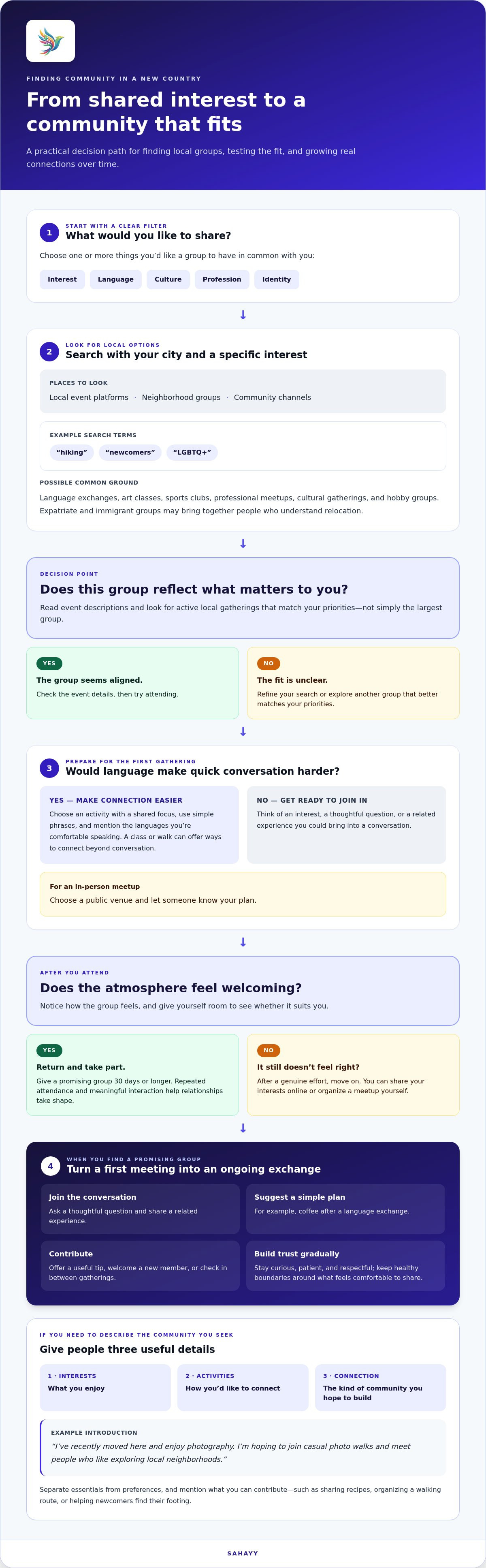
Start with a clear filter: choose an interest, language, culture, profession, or identity you’d like a group to share. Search local event platforms, neighborhood groups, and community channels using your city alongside terms such as “hiking,” “newcomers,” or “LGBTQ+.” Look for active local gatherings that match your priorities, rather than choosing a group simply because it’s large.
Language exchanges, art classes, sports clubs, professional meetups, and cultural gatherings are all ways to meet people with shared interests. Expatriate and immigrant groups can make introductions easier by bringing together people who understand relocation, while activity-based groups create common ground. At a cooking meetup, for example, the food gives conversation a natural starting point.
To find culturally specific, LGBTQ+, professional, or hobby-based communities, combine the category with your city in a group search, then read event descriptions before joining. If you’re building a support network abroad, local support network ideas can help you think about the connections you want.
Language barriers can make quick conversations harder. Choose activities with a shared focus, use simple phrases, and mention the languages you’re comfortable speaking in your introduction. A class or walk can offer other ways to connect beyond conversation alone.
Try a group before committing: attend an event, notice whether the atmosphere feels welcoming, and consider returning. Give a promising group 30 days or longer to see whether it suits you. Feeling socially connected has no fixed timeline; repeated attendance and meaningful interaction help relationships take shape.
For an in-person meetup, choose a public venue and let someone know your plan. If the group doesn’t feel right after a genuine effort, move on. You can also share your interests online and organize a meetup yourself.
2. Participating and building relationships
To make friends after moving, turn a first meeting into an ongoing exchange. Join the conversation, ask a thoughtful question, and share a related experience. If you connect with someone, suggest a simple plan, such as coffee after a language exchange. Following up and returning to an activity can help acquaintances become familiar faces.
Friendships across cultural differences grow through curiosity, patience, and respect. Ask about a custom rather than assuming what it means, and share your own perspective without expecting someone else to represent an entire culture. Trust develops gradually as conversations deepen. Healthy boundaries let you stay open while choosing what feels comfortable to share.
Confidence doesn’t require feeling outgoing every time. Self-acceptance can make introductions feel less like a performance: name an interest, listen closely, and let the conversation unfold. At a book group, for instance, ask another member what they enjoyed about the reading. Small, specific exchanges give both people an easy way to respond.
Relationships also strengthen when you contribute, not only when you seek support. Offer a useful tip, welcome a new member, or check in with a group between gatherings. A daily check-in can help an international exercise group keep shared encouragement present in everyday life. Finding your tribe in a new country is an ongoing process, shaped by honest participation and new connections. For more ways to connect locally, explore community connections.
When you meet someone you’d like to know better, invite them to get together. Asking to stay in touch and making a plan can open the door to friendship. Keep contributing by joining conversations, asking questions, sharing experiences, and offering support to others.
Trust grows as you get to know one another through deeper conversations and shared experiences. Practicing self-acceptance can build confidence and make approaching new people feel more comfortable. An authentic community takes effort and mutual support, with members helping one another form connections.
3. Communicating what kind of community you seek
A clear description helps people recognize shared interests and respond with useful invitations. Go beyond labels such as “expat group” or “making friends.” Name what you enjoy, how you like to connect, and what kind of atmosphere feels comfortable. For example, you might be looking for a relaxed weekend cycling group that welcomes beginners.
Try a simple introduction with three details: your interests, activities you’d enjoy, and the connection you hope to build. You could write, “I’ve recently moved here and enjoy photography. I’m hoping to join casual photo walks and meet people who like exploring local neighborhoods.” Specific details give people an easy way to suggest a group or invite you along.
Separate essentials from preferences. If you want a welcoming space to practice the local language, say so. If you’d also enjoy coffee after a class, describe that as a bonus. Mention what you can contribute, too, such as sharing recipes, organizing a walking route, or helping newcomers find their footing.
Post your introduction in a relevant group or personal blog, then make it easy for people to respond. Ask whether anyone knows a suitable book discussion or would like to plan a beginner-friendly photography walk. If replies point you toward a community you hadn’t considered, adjust your description. Finding your tribe in a new country can begin with a few honest details that help the right people find common ground.
Share what you’re looking for in a relevant online group or blog to help others connect with you. A clear, genuine invitation makes it easier for people with similar interests to recognize a possible connection and reach out. Leave room for suggestions and conversation.
Sahayy: Sahayy Mobile App
Sahayy brings local events, groups, services, and a community marketplace together in one mobile app. If you’re ready to turn your interests into local connections, use Event Discovery and Posting to find gatherings or share an event with others. The Community Marketplace also gives you a place to explore community listings. For questions, Commy AI Assistant can respond in multiple languages, which may help as you learn how local groups work.
Use Sahayy as a practical way to find local activities and community listings, then take the next step in person: join a gathering, start a conversation, and follow up with the people you meet. Groups, events, services, and Marketplace listings are free to use.
Visit Sahayy to explore the app.
Make room for connection to grow
Belonging isn’t a box to tick after moving. It takes shape through the choices you make about how you spend your time and whom you invite into it. Finding your tribe in a new country can also mean discovering new parts of yourself and letting your idea of community evolve as your life changes.
Keep creating chances to connect, even when an introduction leads somewhere unexpected. Shared interests can open a door, while care, consistency, and mutual support help a place feel more like home. Take the next step at your own pace and stay open to people and communities you haven’t met yet.
Your next meaningful connection may begin with a simple hello.
Frequently Asked Questions
What local clubs, classes, volunteer opportunities, and events are good for meeting people?
Choose activities that bring people together around a shared task, such as community gardening, neighborhood cleanups, choir rehearsals, or library conversation circles. Volunteering at a food pantry or local festival can make conversation easier because you’re working toward something together. Check community calendars for recurring events, then choose one where you can participate rather than just observe.
What are common risks when meeting people from online groups in person, and how can you stay safe?
For an in-person meetup, choose a public venue and let someone know your plan. If the group doesn’t feel right after a genuine effort, move on.

Article by
Vinay Patil
Vinay Patil is the founder of Sahayy, a community platform inspired by his own experience of moving to a new country and having to figure out things that someone already there could have answered in minutes. He believes that belonging is built through small acts of helping — sharing an event, answering a question, recommending a service, or simply connecting someone with the right people. With nearly two decades of experience in technology, Vinay is building Sahayy to make it easier for people to find trusted communities and feel at home, wherever they are in the world.
More at https://vinaypatil.com


