

The right nanny-share partner matters as much as the nanny. Start by looking for a nearby family through local expat nanny share groups, then meet to compare schedules, childcare approaches, and expectations. A typical share brings two families together, so both need to feel comfortable with the arrangement.
It’s natural to focus first on finding someone whose children are a good fit for yours. But agreeing on practical details early can make the partnership steadier for everyone, including the nanny.
This guide explains how to find and assess a potential family, divide employment responsibilities, and agree on shared costs. You’ll also find a practical way to manage food, diapers, wipes, and other supplies, so everyday logistics are clear from the start.
Key Takeaways
- Set out each family’s employer responsibilities and agree on how care will work when plans change.
- Compare children’s ages, routines, and care needs to see whether one nanny can support the group comfortably.
- Make a clear plan for food, diapers, wipes, and shared equipment before care begins.
- Use Sahayy Mobile App to discover local communities and connect with families navigating life abroad.
1. Q: Is one family in charge of being the official employer?
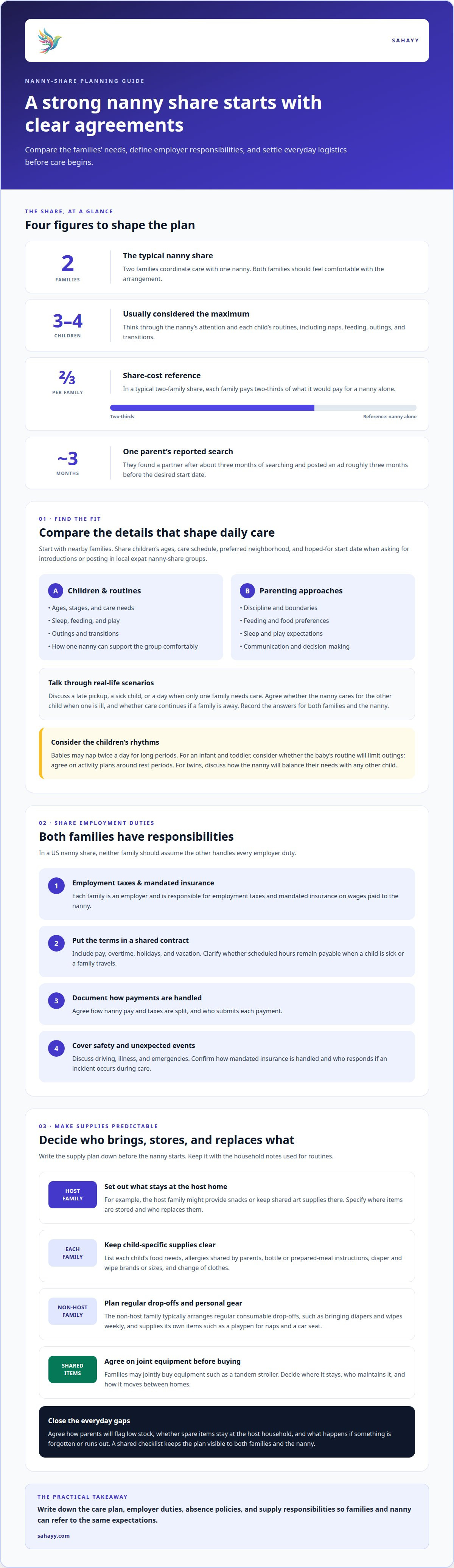
In a US nanny share, neither family should assume the other handles every employer duty. Each family is an employer and is responsible for employment taxes and mandated insurance on wages paid to the nanny. Put responsibilities in a shared contract, including pay, overtime, holidays, and vacation.
A nanny share offers more individualized care for each child and less exposure to illness than daycare. A private nanny gives one household care without coordinating another family, while a share means aligning routines and decisions. Discuss discipline, feeding, sleep, and play before agreeing to start.
Ask a potential share family how they’d handle a late pickup, a sick child, or a day when only one family needs care. Agree on whether the nanny cares for the other child when one is ill, and whether care continues if one family is away. Record the answers for both families and the nanny.
Clarify pay during vacations and absences before signing. For example, agree whether scheduled hours remain payable when a child is sick or a family travels, rather than leaving the question until an absence occurs.
In a typical two-family share, each family pays two-thirds of what it would pay for a nanny alone.
To find a match, post in local expat nanny share groups and ask neighborhood parents for introductions. Then meet the family and nanny together; compare schedules, care expectations, and communication styles. A support network abroad can also help you make local connections.
Split nanny pay and taxes according to the agreed arrangement, and document who submits each payment. Discuss driving, illness, and emergencies, too. Confirm how mandated insurance is handled and who responds if an incident occurs during care.
2. How do you find a nanny share?
Begin with families nearby, since short travel between homes can make shared childcare easier to coordinate. Ask local parents and post in expat nanny share groups with your children’s ages, care schedule, preferred neighborhood, and hoped-for start date. Specific details help potential partners decide whether the arrangement fits.
Plan for a small group: a nanny share typically involves two families, with three to four children usually considered the maximum. That can include infants, twins, or children at different stages, but the nanny’s attention and each child’s routine still need consideration. Discuss how naps, feeding, outings, and transitions would work for the group.
Meet the other parents before deciding. Compare your approaches to discipline, feeding, playtime, and sleep, then talk through examples, such as a toddler grabbing a toy or an infant needing a quiet nap. Parents who communicate openly are better placed to resolve differences before they affect the children.
Sharing care can give children company while preserving more individualized attention than a larger group setting. For twins, ask how the nanny will balance their needs with those of any other child. For an infant and toddler, consider whether the baby’s routine will limit outings. Babies may nap twice a day for long periods, so agree on activity plans around those rest periods.
Give your search time. One parent reported finding a partner after about three months of searching and posting an ad roughly three months before the desired start date. Use that lead time to meet, compare expectations, and decide whether your schedules and childcare priorities align.
3. Negotiating food, diapers, wipes, and other supplies
Put the supply plan in writing before the nanny starts. List what each child uses, where it’s stored, and who replaces it. For example, one family might pack its child’s lunch while the host family provides snacks. Note food preferences, allergies shared by parents, and instructions for bottles or prepared meals.
For consumables such as diapers and wipes, the non-host family typically arranges regular drop-offs, such as bringing supplies weekly. Decide which brands or sizes each child needs, how parents will flag low stock, and whether spare items stay at the host household. A shared checklist can keep these details visible to both families and the nanny.
Keep personal equipment separate from items both families use. The non-host family typically supplies its own items, such as a playpen for naps and a car seat. Families may jointly buy shared equipment, such as a tandem stroller. Before purchasing, agree where the item will stay, who maintains it, and how it moves between homes.
Consider a sample week together: the host family keeps shared art supplies, while each family sends its child’s diapers, wipes, and change of clothes. Decide how to handle forgotten items, food that runs out, and replacements. Record the plan in the same household notes used for routines, so friends don’t have to rely on memory or guess who brings what.
Sahayy: Sahayy Mobile App
Sahayy brings local communities, events, groups, services, and a marketplace together in one app. If you’re settling into a new place and building a support network, use it to discover nearby communities and connect with people who know the area. Those connections can help you meet other parents and start a conversation about shared childcare.
With Sahayy, you can discover or post local events, join community groups, and browse marketplace listings. Commy, the AI assistant, answers questions based on what’s posted in your community and supports queries in multiple languages. These features can help you find local connections; decisions about a nanny share remain between the families and nanny.
Visit sahayy.com to explore Sahayy and find community connections in your area.
Make your next connection locally
Finding a family to share childcare with can also be a first step toward feeling more rooted in your neighborhood. Use conversations sparked by expat nanny share groups to build connections beyond the practical arrangements, while grounding childcare decisions in the agreement between both families and the nanny.
If you’d like to connect with local communities while settling abroad, Sahayy offers a welcoming place to begin. Explore groups, events, and community services, then take the next step at your own pace.
Frequently Asked Questions
How do you find a nanny share?
Start with nearby parent communities and describe the care you need in a clear post. Include your neighborhood, schedule, children’s ages, and preferred start date so potential partners can assess the fit. Expat nanny share groups can help you meet families with similar needs. Before committing, talk with the other parents and nanny about routines and communication.
Is one family in charge of being the official employer?
No. In the United States, each family in a nanny share is an employer and is responsible for employment taxes and mandated insurance on wages paid to the nanny. A payroll service can process nanny pay weekly or bi-weekly, while families file their taxes separately. Write down who handles each payment and keeps the related records.
Should the person whose home is used exclusively be compensated for wear and tear?
Families should discuss whether the host household receives a contribution for the extra use of its space. Consider practical factors such as cleaning, shared utilities, and where children’s belongings are stored. If the families decide on compensation, record the amount and payment schedule in their agreement. They can also discuss rotating hosting if that suits both households.
What if the children do not get along?
Give the children opportunities to spend time together before care begins, with both parents present. Notice specific situations, such as sharing toys or moving between activities, rather than expecting an instant friendship. If tension continues, parents and the nanny can adjust activities, set consistent boundaries, and agree how they’ll communicate about incidents.
Who sets up the match?
Usually, a parent takes the first step by posting in a neighborhood group or asking local parents for introductions. The families then meet, compare schedules, and include the nanny in conversations about care expectations. The match works best as a shared decision: parents explain the children’s needs, and the nanny discusses how the proposed routine would work in practice.

Article by
Vinay Patil
Vinay Patil is the founder of Sahayy, a community platform inspired by his own experience of moving to a new country and having to figure out things that someone already there could have answered in minutes. He believes that belonging is built through small acts of helping — sharing an event, answering a question, recommending a service, or simply connecting someone with the right people. With nearly two decades of experience in technology, Vinay is building Sahayy to make it easier for people to find trusted communities and feel at home, wherever they are in the world.
More at https://vinaypatil.com


