

For an expat entrepreneur, the right peer group can turn a good intention into a practical next step. A small-business mastermind group brings entrepreneurs together to discuss goals, share ideas, collaborate, and hold one another accountable. These groups commonly have 6 to 12 members, though some have as few as 3. A mastermind group for expat entrepreneurs can offer a space to work through the distinct challenges of building a business while living abroad.
Running a business in another country can mean making decisions without the familiar network you once relied on. It makes sense to look for both practical advice and peers who’ll help you follow through.
Learn what mastermind groups do, how meeting formats and shared commitments build accountability, and what makes peer support useful for expat entrepreneurs. You’ll also find ways to connect with local communities and events as you build your business life abroad.
Key Takeaways
- Use a clear meeting goal and a specific next step to turn peer discussion into action.
- A rotating hot seat gives one member focused time to work through a challenge while others offer constructive perspectives.
- Build a supportive group around shared values, complementary strengths, trust, and a willingness to follow through.
- Local events and communities can help you find connection abroad and complement the focused support of a mastermind.
1. What Is a Mastermind Group for Small Businesses?
A small-business mastermind group brings business owners together to discuss goals, share feedback, and solve practical challenges. Groups commonly have 6 to 12 members, though some have as few as 3. A useful meeting gives each person room to contribute, rather than leaving discussion to the leaders or most experienced members.
Members learn by sharing perspectives and taking action. For example, a founder reviewing revenue goals might hear how another member tests a new offer, then adapt that approach to their own market. Members can also develop personal skills, such as making decisions with more confidence and listening to constructive feedback. This blend of peer learning and follow-through sets a mastermind apart from studying business concepts alone.
In-person meetings make face-to-face discussion and relationship-building easier. Online meetings let members participate across borders without travelling, which can suit entrepreneurs living abroad or working across locations. A hybrid circle can offer both formats, but needs a clear plan so remote members can contribute equally. For practical ideas on building a support network abroad, consider how local connections can complement business peers.
Networking groups focus mainly on introductions and exchanging contacts, while coaching usually centres on guidance from a coach. A mastermind depends on members sharing experience, challenging ideas, and supporting one another’s next steps.
Membership expectations vary. Before joining, understand the group’s purpose, meeting structure, expected contributions, and what members gain. Clear objectives and confidentiality rules help create space for candid discussion.
A paid group may be a poor fit if its format, member expectations, or feedback don’t match your needs. Before committing, review what participation involves and whether the group’s approach supports your goals.
2. Establishing accountability and actionable outcomes
A focused meeting starts with a clear goal, not a round of general updates. Each member can name a business priority, explain the obstacle, and identify the decision they need to make. This keeps a business mastermind practical, with discussion linked to outcomes rather than broad encouragement.
A rotating hot seat gives one member attention for their biggest challenge. For example, a founder struggling to reach local customers can share their approach, then invite questions and alternative perspectives. One suggested format allocates 80% of each session to members defending their thinking or applying others’ perspectives. Respectful disagreement can reveal weak assumptions and produce more useful insights.
Turn discussion into accountability with a simple sequence: define an action, assign an owner, and report progress at the next meeting. “Improve sales” is hard to track; testing a revised offer with potential customers is more actionable. At the follow-up, the founder can share what happened and decide what to change next.
Peer accountability works best when members listen closely and challenge ideas without dismissing the person. If someone says they’ll postpone a decision until conditions feel perfect, peers can ask what small step they could take now. This offers support and momentum without replacing the founder’s judgment.
Set confidentiality rules and shared objectives before the first hot seat. Members need to know which details stay in the group and how feedback should be delivered. For business connections beyond dedicated meetings, discover local events where entrepreneurs can meet peers and exchange ideas.
3. Mastermind groups for expat entrepreneurs
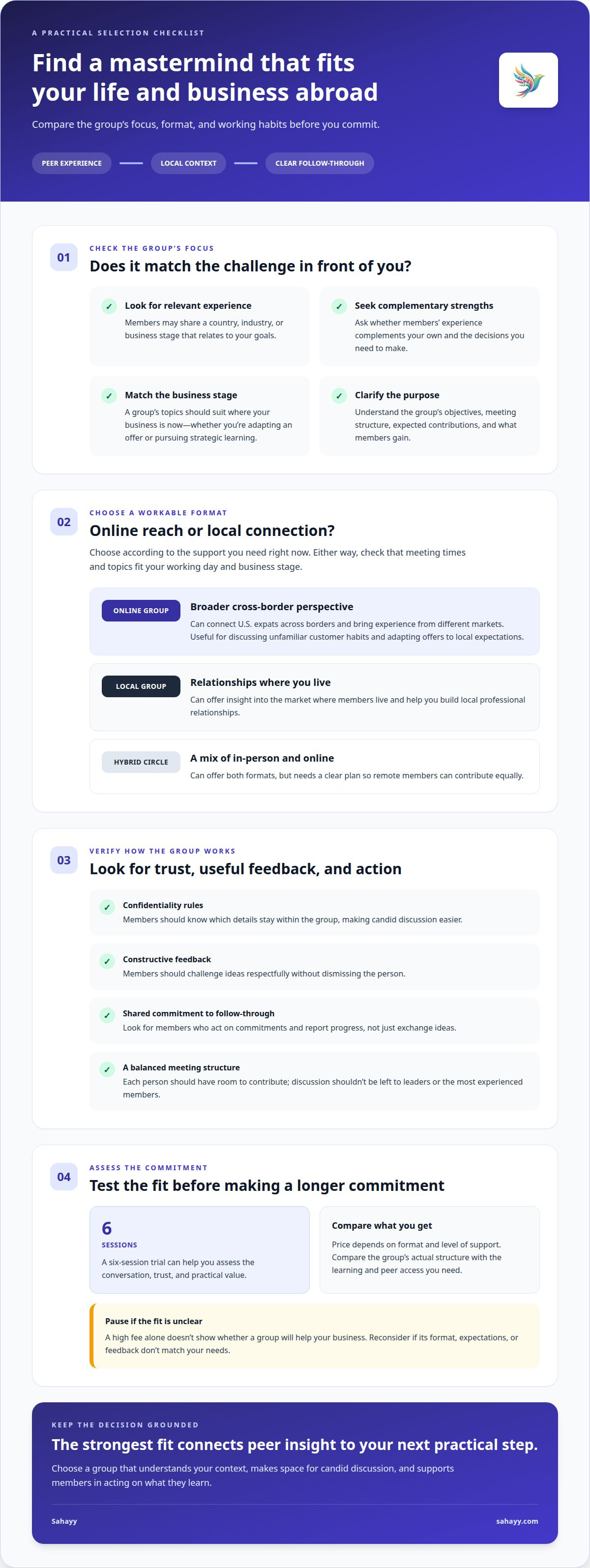
Building a business abroad can mean learning unfamiliar customer habits while rebuilding professional relationships. A peer group with cross-border experience can make these challenges easier to discuss honestly. For example, an owner entering a new market can ask how members adapt an offer to local expectations, then decide what to test.
Online mastermind groups let U.S. expats join conversations across borders, while local groups can offer insight into the market where members live. Choose based on your immediate need: online peers may bring broader experience, while in-person owners can help you build local professional relationships. Make sure meeting times and topics suit your working day and business stage.
The price depends on the format and level of support, so compare the group’s actual structure with the learning and peer access you need. A high fee alone doesn’t show whether a group will help your business.
To find a reputable group, look for clear objectives, confidentiality rules, constructive feedback, and members who act on their commitments. A six-session trial can help you assess the conversation, trust, and practical value before making a longer commitment. Ask how members are selected and whether their experience complements your own.
Groups may focus on a country, industry, or business stage, bringing together members with relevant goals and complementary expertise. A founder preparing for a conference, for instance, may value peers who understand international networking; an established owner may be looking for strategic learning.
Online mastermind groups with cross-border experience can help U.S. expats discuss unfamiliar customer habits, adapt offers to local expectations, and build business skills abroad. Look for a group focused on a relevant country, industry, or business stage, with clear objectives, confidentiality rules, constructive feedback, and members whose experience complements your own.
Sahayy
Sahayy helps expat entrepreneurs build local connections alongside the focused support of a mastermind. In the Sahayy Mobile App, discover community events and groups, find local services, and explore the Community Marketplace. Event Discovery and Posting helps you connect with people nearby, while the AI assistant Commy answers queries in multiple languages.
Use these community connections to broaden your local perspective, meet potential collaborators, or feel more connected to the place where you’re building your business. Sahayy complements peer accountability; it doesn’t replace the shared goals and regular feedback of a mastermind group.
Contact Sahayy to explore community connections that fit your life abroad.
Make your next connection count
Choose a peer circle that fits the business you’re building and the life you’re creating abroad. A well-matched expat entrepreneurs mastermind group gives you space to think out loud, learn from others, and turn an intention into a next step. Keep your goals at the centre: useful support helps you make decisions, not just collect advice.
Local relationships can bring fresh perspectives beyond your regular business conversations. Sahayy helps people living abroad discover community connections, offering another way to feel rooted while growing your work.
Your next useful conversation could start with a clear goal and an open mind.
Frequently Asked Questions
What Is a Mastermind Group for Small Businesses?
A mastermind is a peer group where business owners help one another think through decisions and challenges. For example, a founder preparing to hire can discuss the role, timing, and lessons from members who have hired before. The group offers perspectives and shared experience; each owner remains responsible for deciding what suits their business.
What is an expat entrepreneur mastermind group?
An expat entrepreneur mastermind group brings together business owners living abroad to share experience and support one another’s growth. Members might compare ways to understand a new customer base, build professional relationships after relocating, or manage work across time zones. Their shared experience of living abroad can make conversations more relevant to everyday business challenges.
What are the best mastermind groups for expat entrepreneurs in 2026?
The best fit is a group whose members and purpose match your business needs. A founder entering a new country may value peers with local-market experience, while a specialist may prefer owners in the same industry. Look for a clear meeting structure, confidentiality expectations, and a culture where members contribute honestly rather than relying on one person to provide every answer.
What should I expect at a mastermind group meeting?
Expect members to share business updates, bring a question or challenge, and listen closely to others’ experiences. For example, you might explain why a partnership conversation stalled, then hear how peers handle similar discussions. Good participation also means offering thoughtful input when another owner speaks and respecting the group’s confidentiality rules.

Article by
Vinay Patil
Vinay Patil is the founder of Sahayy, a community platform inspired by his own experience of moving to a new country and having to figure out things that someone already there could have answered in minutes. He believes that belonging is built through small acts of helping — sharing an event, answering a question, recommending a service, or simply connecting someone with the right people. With nearly two decades of experience in technology, Vinay is building Sahayy to make it easier for people to find trusted communities and feel at home, wherever they are in the world.
More at https://vinaypatil.com


