

What if the best advice abroad isn’t the most popular recommendation, but the one that fits your neighborhood and needs? It can be hard to know where residents share useful tips, how to ask without feeling awkward, or what to do when suggestions conflict. To get local advice abroad, start with nearby voices, then check important details against reliable official information.
This guide explains how to find local groups and community spaces, ask questions that invite useful answers, and compare recommendations. It also covers how Sahayy brings local events, groups, services, a marketplace, and a multilingual AI assistant together, so you can explore nearby perspectives while keeping official guidance in view.
Key Takeaways
- Use neighborhood-level knowledge to add context that broad search results may miss.
- To get local advice abroad, include your location, timing, preferences, and practical constraints in your question.
- Join relevant community conversations to build a broader picture instead of relying on a single response.
- Explore Sahayy's events, groups, services, marketplace, and multilingual assistant to support local discovery.
Why getting local advice abroad can beat generic search results
Search results can point you toward popular attractions or widely recommended services, but they may not reflect the neighborhood where you live, your daily routine, or what you need. Local advice is place-specific knowledge shared by people familiar with an area’s everyday choices, customs, services, and activities. A resident might suggest a family-friendly event nearby or a group that meets around a particular hobby. Treat that experience as one perspective, not a guarantee that the same option will suit everyone.
Local context can help you get advice abroad that feels relevant rather than generic, and it may surface questions you hadn’t thought to ask. But one person’s recommendation is only one data point. People have different needs, budgets, routines, and experiences, so compare suggestions when a decision matters.
Which questions benefit most from local context?
Ask about choices shaped by neighborhood knowledge and daily life. For example, find out where newcomers meet people, what activities are happening nearby, or what residents consider when choosing an everyday service. Include your area and priorities so people can give useful context. Community perspectives can help you discover options, but they aren’t a substitute for professional or official advice.
- “Are there social groups or activities near my neighborhood?”
- “What should I consider before using this everyday service?”
- “Which community events might suit someone with my interests?”
For legal or immigration questions, or urgent safety concerns, use appropriate official sources rather than relying on community replies. Travel advisories and emergency information can change, so check current guidance from relevant authorities. Community conversations are best for local context and connection, not time-sensitive instructions. Building relationships can also make it easier to hear different perspectives over time; a support network abroad can help you feel more connected as you settle in.
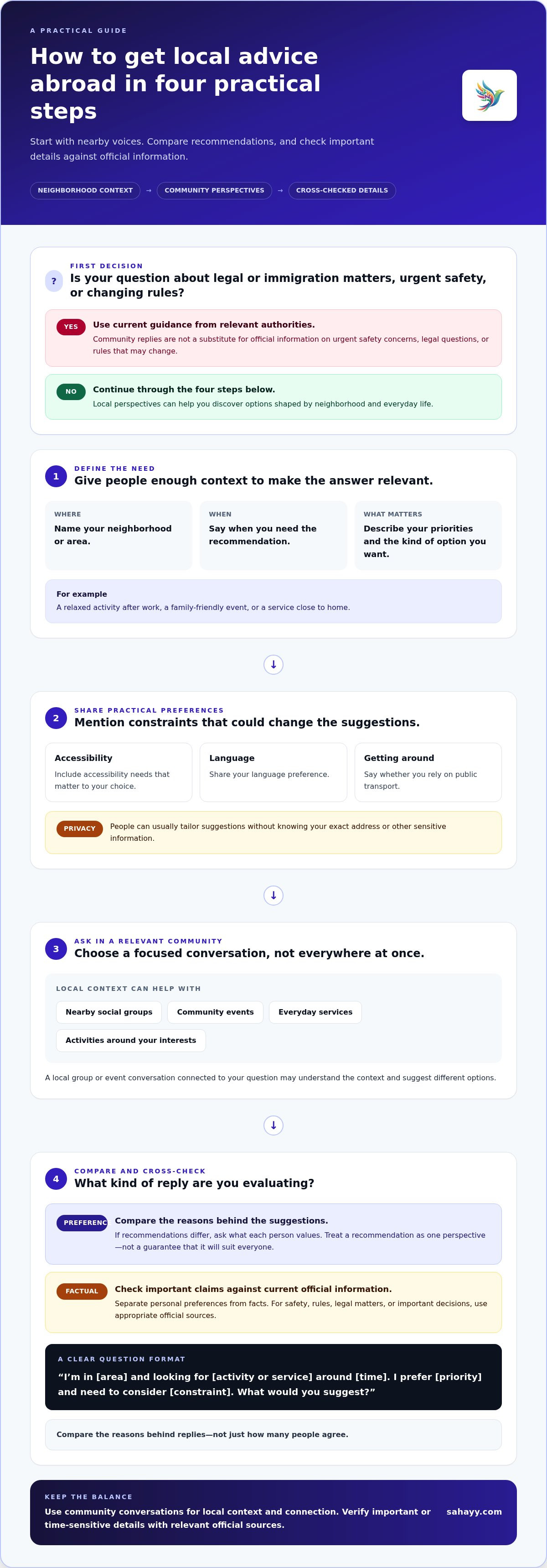
How to get local advice abroad in four practical steps
A focused question is easier to answer than “What should I do here?” Use these steps to get local advice abroad that reflects your situation and gives you useful options to compare.
- Define the need. Name the neighborhood or area, when you need the recommendation, and what matters to you. For example, say whether you’re looking for a relaxed activity after work, a family-friendly event, or a service close to home.
- Share practical preferences. Include factors that shape the answer, such as accessibility needs, language preference, or whether you rely on public transport. Protect your privacy: people can usually tailor suggestions without knowing your exact address or other sensitive information.
- Ask in a relevant community. Look for a local group or event conversation connected to your question instead of posting it everywhere. A focused audience is more likely to understand the context and may suggest different options.
- Compare and cross-check. Separate personal preferences from factual claims. If recommendations differ, ask what each person values. For safety, rules, or important decisions, look for current information from appropriate official sources.
How can you ask a clear question and judge the replies?
Try this format: “I’m in [area] and looking for [activity or service] around [time]. I prefer [priority] and need to consider [constraint]. What would you suggest?” Compare the reasons behind replies, not just how many people agree. Ongoing connections can make future questions feel more natural; this guide to building a support network abroad offers ideas for finding that sense of community.
To find local groups and conversations in one place, explore Sahayy’s community platform, which brings events, groups, and services together.
Make local advice abroad easier to find through community
A single recommendation can be helpful, but it reflects one person’s experience. Ongoing groups and community conversations give you more chances to discover activities, hear different perspectives, and learn what matters to people nearby. Familiar spaces can also make it easier to ask follow-up questions and decide which suggestions fit your needs.
Community listings can reveal activities you might not think to search for directly, from casual meetups to interest-based events. A guide to finding local events can help you turn discovery into a practical way to explore what’s happening nearby.
How can a community platform support local discovery?
Sahayy brings local groups, events, services, and marketplace listings together in one app for people living abroad. You can join nearby communities, explore events and services, and post listings in the marketplace. Its multilingual AI assistant, Commy, answers queries in multiple languages, which can help when you’re working through a language barrier or deciding how to phrase a question.
Use listings and replies as starting points for discovery, not as a substitute for your own judgment. A listing or response is not a guarantee, and community information shouldn’t replace official guidance for urgent safety concerns, legal questions, or rules that may change. For important decisions, compare what you find with relevant official sources.
To make local discovery more useful, look beyond one search or conversation. Explore a group related to your interests, scan event listings for activities that fit your schedule, and revisit community conversations as your questions change. That way, local knowledge can build gradually instead of resting on one recommendation.
If you’d like a community resource for exploring nearby connections and information, explore Sahayy.
Turn local discoveries into lasting connections
Your next step doesn’t have to be a major one. Choose a question you’d like answered, explore a community that shares your interests, or join an activity that helps you feel more at home. Small connections can make an unfamiliar place easier to navigate, one conversation at a time. As you get local advice abroad, check important details against official sources when decisions involve safety, rules, or changing information.
Sahayy supports ongoing discovery by bringing local events, groups, services, and a marketplace together. Its core app features are free, and Commy answers queries in multiple languages, helping you explore and ask questions across language barriers.
Start with one question, then use each new connection to feel more at home.
Frequently Asked Questions
Is local advice abroad always more reliable than online travel guides?
No. Each source offers a different kind of help, and local recommendations aren’t automatically more reliable. A resident might share a useful perspective on a neighborhood café, while a travel guide may help you plan a broader itinerary. For details that can change, such as entry requirements, health guidance, or urgent safety updates, check the relevant official source.
Can I get useful local advice abroad if I do not speak the local language?
Yes. You can get local advice abroad by keeping your question short and naming the place or activity you mean. If you use a translation tool, ask for a reply in clear, simple language and confirm key details such as an address or date before acting. For official instructions or high-stakes matters, consult the relevant authority and use a reliable translation.
How far ahead should I ask for local recommendations while travelling?
Ask early if your plan depends on a particular date, reservation, or opening time. For a flexible walk or casual activity, asking closer to the day may be enough. Timing varies by place and type of plan, so confirm current details before you leave. If a suggestion depends on a schedule, check that schedule directly rather than relying on an older reply.
What should I do if local recommendations contradict one another?
Contradictory replies may reflect different priorities, not necessarily a mistake. One person might favor a quiet setting, while another values convenience. Ask a follow-up about the reason behind each suggestion, then decide which factors matter most to you. If the disagreement concerns safety or rules, look for up-to-date official information before making a decision.

Article by
Vinay Patil
Vinay Patil is the founder of Sahayy, a community platform inspired by his own experience of moving to a new country and having to figure out things that someone already there could have answered in minutes. He believes that belonging is built through small acts of helping — sharing an event, answering a question, recommending a service, or simply connecting someone with the right people. With nearly two decades of experience in technology, Vinay is building Sahayy to make it easier for people to find trusted communities and feel at home, wherever they are in the world.
More at https://vinaypatil.com


