

What if the best way to promote diaspora networking events isn’t to reach more people, but to reach the right local community? A broad event listing can be easy to publish and still miss its intended audience. Organizers need channels that feel relevant and trustworthy, then measures that show what happened beyond an estimate of potential attendance.
This 2026 case study outlines a community-first approach: make event details useful to local searchers, share them where relevant community groups can find them, and track only results you can verify. You’ll learn how to compare channels and assess whether Sahayy fits your goals. Sahayy offers event discovery and posting alongside community groups. Core app features are free, with sponsored visibility as a paid option. Neither channel guarantees turnout, so the focus is on audience fit, trust, and clear measures of response.
Key Takeaways
- Define the event’s purpose and intended local audience before choosing where to promote it.
- For diaspora networking events, weigh cultural and community relevance alongside each channel’s potential reach.
- Use the illustrative Berlin example to see how event details, audience selection, and community sharing can work together.
- Compare channels by audience fit and organizer effort, then review only results you can measure reliably.
What Makes Diaspora Networking Events Relevant to a Local Community?
Diaspora describes communities living beyond an ancestral or national homeland. Diaspora networking events bring people together around shared professional, cultural, or community interests. Their value isn’t measured by exposure alone. A useful invitation tells people what the gathering is for, where and when it takes place, and whether they are likely to feel welcome.
Community-first event promotion puts relevance before reach: it meets a particular audience in the language, place, and context that make the invitation meaningful.
How Can Organizers Tell Whether an Event Fits Its Community?
Start with the event’s purpose, then identify the local audience most likely to value it. Don’t treat diaspora groups as interchangeable: people with a shared background may have different interests, languages, and needs. Check whether the timing and venue work for the people you hope to welcome. Make the event’s cultural or professional context clear, without assuming that everyone in the audience has the same experience.
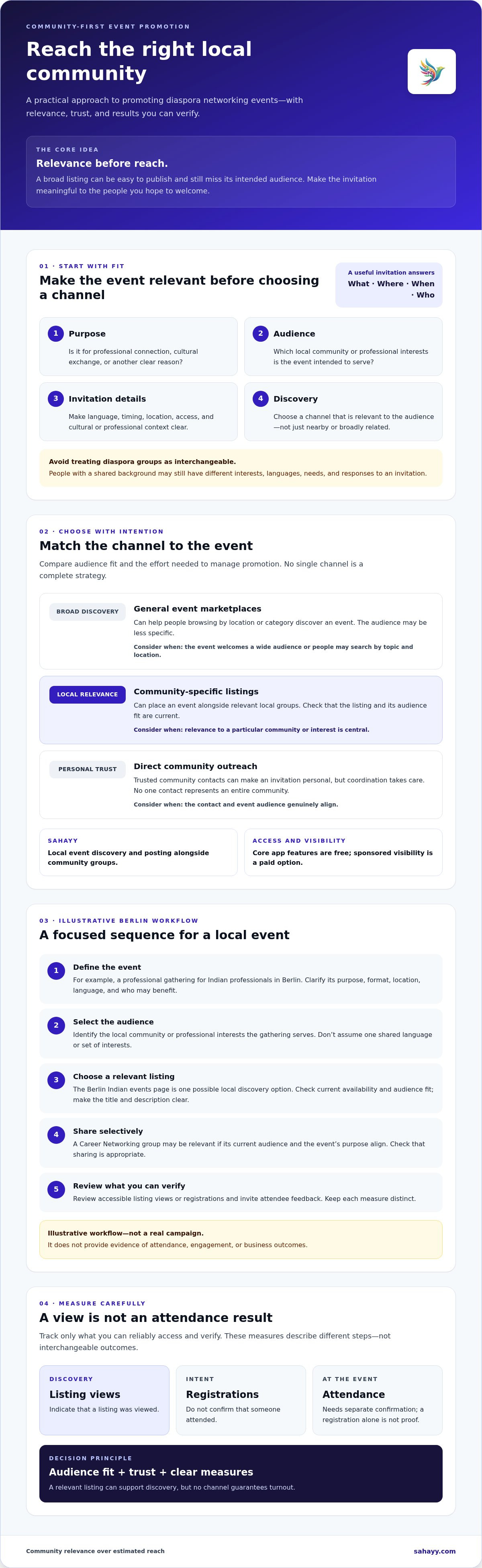
Use this checklist before choosing promotion channels:
- Purpose: Is the gathering for professional connection, cultural exchange, or another clear reason?
- Audience: Which local community or interest group is it intended for?
- Invitation: Are the language, timing, location, and access details clear enough for someone to decide whether to attend?
- Discovery: Can people find it through a channel relevant to that audience?
Sahayy offers local event discovery and posting alongside community groups. Organizers can review its Berlin Indian events page as one possible discovery channel, checking that the page and audience fit are current before relying on it. Use the checklist to decide whether a local listing complements your other promotion, rather than treating any single channel as a complete strategy.
An Illustrative Berlin Example: Promoting a Diaspora Networking Event
This is an illustrative workflow, not a real Sahayy campaign. It doesn’t provide evidence of attendance, engagement, or business outcomes. Imagine an organizer planning a professional gathering for Indian professionals in Berlin. The goal is not to reach every diaspora community. It is to make the event easy for the intended audience to understand, assess, and find.
A Practical Promotion Sequence for a Berlin Indian Community Event
Use this sequence to plan promotion for diaspora networking events:
- Define the event. Write down its purpose, format, location, language, and who is likely to benefit. Include the details a potential attendee needs to decide whether it fits.
- Select the audience. Identify the local community or professional interests the event serves. Don’t assume a group shares one language, set of interests, or response to an invitation.
- Choose a relevant listing. After checking current availability, consider the Berlin Indian events page as one local discovery option. Use a concise title and description that make the event’s purpose and audience clear.
- Share selectively. A Career Networking group may be relevant if its current audience and the event’s purpose align. Check that sharing is appropriate, and don’t post simply because a group is nearby or shares a broad identity.
- Review what you can verify. After the event, review accessible listing views or registrations and invite attendee feedback. Keep each measure distinct: a view is not a registration, and a registration does not confirm attendance.
For attendee-focused preparation, organizers can also point guests to a guide on networking for people living abroad. A relevant local listing can support discovery, but it can’t promise turnout. Organizers considering Sahayy can learn about the platform and assess whether its event and community features fit their plans.
How to Compare Event Promotion Channels and Choose Your Next Step
For diaspora networking events, the right channel depends on the audience you need to reach and the time you can spend managing promotion. Broad event marketplaces can help people browsing by location or category discover a gathering, though that audience may be less specific. Community platforms can put an event alongside relevant local groups. Direct outreach through trusted community contacts can make an invitation personal, but requires coordination and care. Don’t assume any one contact represents a whole community.
Which Promotion Channel Fits Your Event Goals?
Use this comparison to choose where to start:
- Broad discovery: Consider a general marketplace if your event welcomes a wide audience or people are likely to search by topic and location.
- Community-specific listings: Consider a local platform when relevance to a particular community or interest is central. Sahayy brings local events and community groups together as one discovery option.
- Direct outreach: Contact relevant organizations or group administrators when a personal invitation suits the event. Allow time to check that sharing is welcome.
A mix of channels may make sense, but note which one generated each response when that information is available. Review listing views, registrations, attendance, and feedback only when you can access reliable data. Don’t count a view as a registration or a registration as attendance. If you can’t verify a figure, leave it out of your assessment.
Sahayy’s core app features are free, while sponsored visibility is a paid option. Confirm current sponsored listing details and organizer eligibility before planning around it; promotion doesn’t guarantee attendance. Explore Sahayy to decide whether its event discovery and community features suit your goals.
Build Your Next Event Around Community
Strong diaspora networking events begin with a clear purpose and an invitation shaped for a particular local audience. Language, location, timing, and cultural context can make an event feel relevant in ways broad exposure alone may not. Choose channels based on audience fit and the effort your team can sustain. Then review results you can verify, such as registrations or attendee feedback, without treating them as interchangeable.
Sahayy brings local events and community groups together in one platform, giving organizers another place to support local discovery. Core app features are free, while sponsored visibility is a paid option. Check current options and eligibility before deciding whether it fits your plan, and remember that no channel guarantees attendance.
With thoughtful promotion and honest measurement, each event can become a more welcoming starting point for connection. Start with the audience’s needs, make the invitation easy to assess, and use feedback to inform your next event.
Frequently Asked Questions
How can businesses promote diaspora networking events?
Businesses can promote diaspora networking events by defining a specific local audience, then choosing channels that audience is likely to use. Create a clear listing with the event’s purpose, language, location, timing, and access details. Share it through relevant community groups or trusted local contacts where appropriate. Afterward, compare views, registrations, attendance, and feedback only when reliable data is available. Promotion can’t guarantee turnout.
What makes a diaspora networking event successful?
A successful diaspora networking event starts with a clear purpose and an audience with a genuine reason to attend. Make practical details easy to find, including the venue, timing, language, accessibility, and what participants can expect. Welcoming facilitation can help people connect rather than leaving introductions to chance. Choose measures that match your goals, such as useful conversations or attendee feedback, without assuming a universal benchmark.
Can event platforms help organizers reach diaspora communities?
Event platforms can help organizers share details, but channel fit varies. Broad marketplaces support discovery by location or category and may reach people outside the intended community. Community-focused platforms can place listings alongside local groups and interests. Sahayy brings local events and groups together, but local reach depends on audience activity and listing relevance. No platform can promise attendance.
How can I find diaspora networking events near me?
To find diaspora networking events near you, search local event listings and community platforms by city, interest, or cultural focus. Check relevant groups for event announcements, too. Visit the organizer’s page or contact them to confirm the date, venue, language, access information, and registration details. Listings can change, so verify the information before making plans. A local search is a starting point, not a guarantee of availability.

Article by
Vinay Patil
Vinay Patil is the founder of Sahayy, a community platform inspired by his own experience of moving to a new country and having to figure out things that someone already there could have answered in minutes. He believes that belonging is built through small acts of helping — sharing an event, answering a question, recommending a service, or simply connecting someone with the right people. With nearly two decades of experience in technology, Vinay is building Sahayy to make it easier for people to find trusted communities and feel at home, wherever they are in the world.
More at https://vinaypatil.com


