

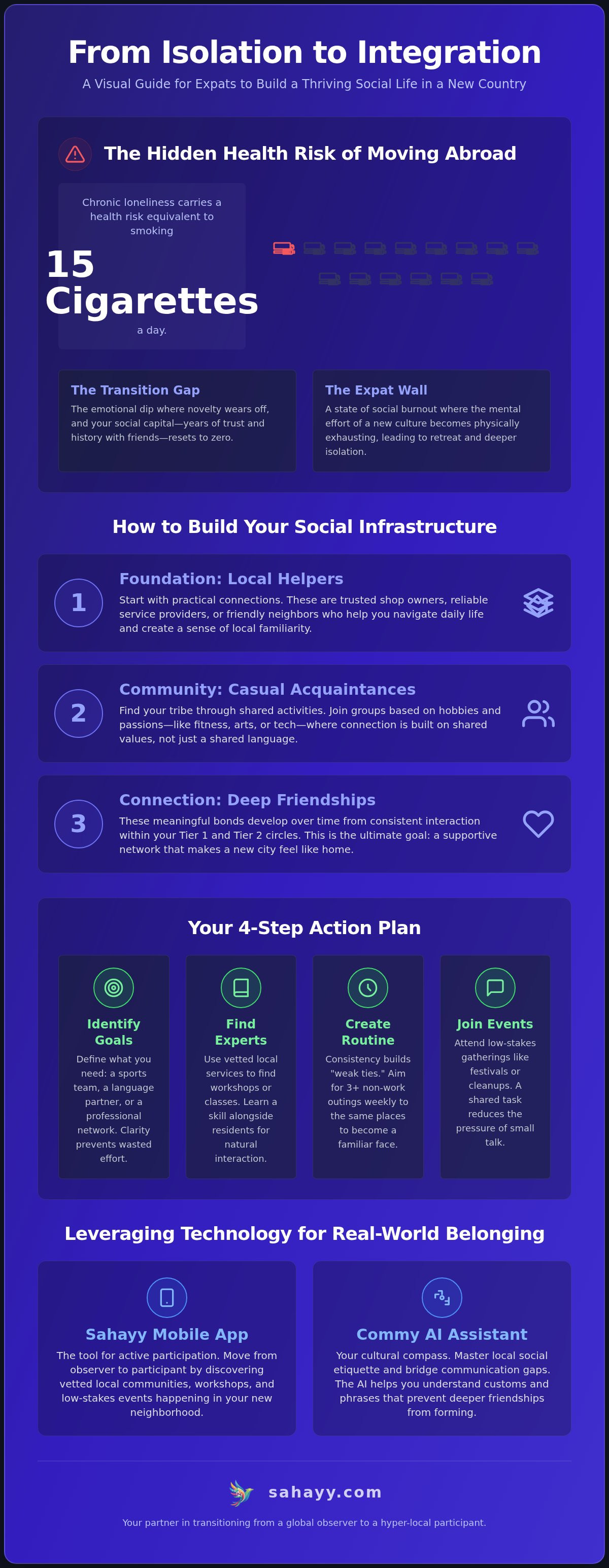
Did you know that chronic loneliness carries health risks equivalent to smoking fifteen cigarettes a day? For the millions of us moving across borders in 2026, this isn't just a statistic. It's a daily weight that makes even the most beautiful sunset in Lisbon feel hollow. You've likely felt the exhaustion of starting over socially, missing friends who know your stories by heart. Overcoming loneliness abroad is a structural hurdle, not a personal failure. As the old wisdom suggests, a neighbor nearby is often more vital than a relative far away.
This guide offers a compassionate framework to help you move from isolation to a vibrant local circle. We'll explore how to bridge cultural gaps with the Commy AI Assistant, manage relocation stress, and use the Sahayy Mobile App to find your tribe. You'll learn to transition from a global observer to a hyper-local participant. Let's ensure your new city finally feels like home.
Key Takeaways
- Normalize the "transition gap" by understanding why even social experts feel isolated when their social capital resets in a new environment.
- Implement a three-tier support system for overcoming loneliness abroad that focuses on shared values rather than just shared nationality.
- Transform your daily routine by setting specific connection goals and identifying local workshops that foster meaningful community involvement.
- Use the Commy AI Assistant to master local social etiquette and bridge the communication gaps that often prevent deeper friendships.
Why Loneliness is a Natural Part of the Expat Life Transition
Moving to a new country often begins with a honeymoon phase full of discovery. However, once the boxes are unpacked, many expats hit the Transition Gap. This is the emotional dip where the novelty wears off and the silence of a new apartment feels heavy. It's a period where your social capital, the years of trust built with friends back home, resets to zero. Even the most outgoing individuals can feel invisible when they lack a history with the people around them.
This feeling of otherness is often fueled by the natural stages of culture shock. When daily interactions require intense mental effort, it's easy to feel like an outsider. Expat Life Transition Support is a holistic approach to social, emotional, and logistical integration. Understanding these psychological phases is the first step toward overcoming loneliness abroad.
The Difference Between Being Alone and Being Lonely
Physical solitude can be peaceful, but loneliness is the emotional ache of not being seen or understood. Without a familiar support network, small daily stresses, like navigating a grocery store or fixing a leaky faucet, feel magnified. You aren't just missing people; you're missing the safety net of being known by your community.
Recognizing the Signs of Social Burnout
Many newcomers eventually hit the Expat Wall. This is a state of social burnout where the effort to translate customs or speak a new language feels physically exhausting. You might find yourself retreating into your apartment or avoiding local interactions entirely. While it feels like self-protection, this cycle often deepens the isolation. Overcoming loneliness abroad requires recognizing when you're burnt out so you can rest without completely disconnecting from your new neighborhood.
How to Build a Supportive Social Infrastructure Abroad
Building a community isn't about finding one "best friend" immediately. It requires a tiered approach to social infrastructure. First, find local helpers like trusted shop owners or neighbors who help you navigate the system. Next, seek casual acquaintances through shared activities. Finally, nurture deep friendships. Understanding the psychology of expat loneliness helps you realize that these layers provide different types of emotional security. Prioritize shared values like fitness or creative arts over shared nationality. This creates more resilient bonds than simply speaking the same language.
Utilizing newcomer community resources can give you the initial footing needed to identify these tiers. Don't overlook the value of "Third Places." These are neighborhood spots like a specific coffee shop, a community garden, or a local library where you're recognized and welcomed. Being a "regular" reduces the friction of entry into local life. It turns a foreign street into a familiar neighborhood.
Finding Your Cultural Compass
Join groups that align with your existing passions. Whether it's a weekend hiking club or a local gaming cafe, hobbies act as a universal language. Diaspora communities are excellent for a soft landing. They provide immediate comfort and practical advice while you gather the strength to branch out into the wider local culture. Use these groups as a bridge, not a permanent bubble.
The Power of Routine in Reducing Isolation
Consistency is your greatest tool for overcoming loneliness abroad. Attending the same market every Saturday morning creates "weak ties" with vendors and neighbors. These small, repeated interactions eventually lead to deeper connections. Aim for a social calendar where you leave the house at least three times a week for non-work reasons. To get started, you can explore local events through the Sahayy Mobile App to find your next neighborhood gathering.
Actionable Strategies to Discover Local Communities and Events
Building a life in a new country requires moving from passive observation to active participation. While some suggest bars or tourist tours, these often lead to transient connections. Overcoming loneliness abroad is most effective when you focus on sustainable, recurring interactions. Follow these four steps to start your journey.
- Identify Connection Goals: Define exactly what you need. This could be a weekly football game, a language exchange, or a professional network.
- Find Local Experts: Use local service providers for expats to discover vetted classes or workshops where you can learn alongside residents.
- Join Low-Stakes Events: Attend community events like neighborhood cleanups or holiday festivals. These provide a shared task that reduces the pressure of small talk.
- Use Digital Bridges: Leverage tools designed for newcomers that filter for community-first activities to reduce the fear of rejection.
Micro-Networking: Starting Small
You don't need a grand entrance to make an impact. Use the "One Small Ask" technique. Ask a neighbor for a bakery recommendation or a local tip to start a conversation. Additionally, peer-to-peer transactions in a local marketplace allow you to meet neighbors in a safe, structured environment. These tiny moments of trust build the foundation for belonging.
Volunteering as a Social Shortcut
Giving back is the fastest way to stop feeling like a stranger. When you volunteer for a local cause, you transition from someone who uses the city to someone who builds it. Shared action transcends language barriers. Whether you're planting trees or helping at a food bank, the focus is on the mission, not your grammar. This shared purpose creates an instant, meaningful bond with fellow residents.
Leveraging Technology for Real-World Belonging
Technology often gets a bad rap for increasing isolation. If you spend your evenings scrolling through photos of friends back home, it hinders your progress. However, when used correctly, digital tools are the ultimate bridge to physical connection. Overcoming loneliness abroad becomes much easier when your phone acts as a compass rather than a distraction. Instead of doomscrolling, use your devices to map out the physical spaces where your new community gathers.
One of the biggest hurdles is the language barrier and the fear of making a social faux pas. A multilingual AI for expats helps you navigate local social etiquette before you step out the door. It ensures you understand the nuances of a neighborhood gathering or a workshop invitation. Using the Sahayy Mobile App allows you to find hyper-local events that often don't appear on global platforms. These verified communities ensure your exploration remains safe and inclusive.
Meeting Commy: Your Digital Guide to Local Life
The Commy AI Assistant answers cultural questions that might feel too small or embarrassing for a human friend. It acts as your private tutor for local life. Use it to translate event descriptions or community posts to find hidden gems in your neighborhood. This removes the friction of entry into new social circles. It's a vital tool for overcoming loneliness abroad by giving you the confidence to engage with your neighbors in their own language.
The Frictionless Move: Joining Sahayy
Sahayy aggregates events, groups, and a marketplace into one supportive ecosystem. It's designed to help you transition from a stranger to a local with minimal effort. By focusing on the hyper-local level, we ensure you find connections that are sustainable and close to home. Ready to stop feeling like a stranger? Join the Sahayy community today and find your local tribe.
Your Path to Belonging Starts Today
Building a life in a new country is a brave transition that takes time and patience. We've seen how loneliness is a structural part of the relocation process rather than a personal failing. By building a tiered social infrastructure and prioritizing shared values, you can turn a foreign street into a familiar neighborhood. Overcoming loneliness abroad is a journey that moves you from being a global observer to a hyper-local participant.
You don't have to navigate this path alone. With the Commy AI Assistant providing support in your native language and a safe, verified marketplace for peace of mind, the friction of starting over disappears. These tools are trusted by diaspora communities worldwide to foster genuine discovery and security. You're joining a collective story where every neighbor is a potential friend.
Your new city is waiting to welcome you. Take that first step toward your tribe and watch as your new house finally starts to feel like a home. You've got the tools and the framework; now it's time to find your place in the community.
Frequently Asked Questions
How long does it typically take to stop feeling lonely after moving abroad?
Most expats find that the initial honeymoon phase fades after about three months, leading to a period of increased isolation. Achieving a true sense of belonging typically takes between six and twelve months of consistent effort. Overcoming loneliness abroad isn't an overnight process; it requires building a new social infrastructure from scratch. Be patient with yourself during this transition, as establishing deep, reliable connections in a new culture takes time and repetition.
Is it better to make friends with other expats or with locals first?
Both groups serve essential roles in your social health. Expats offer a soft landing because they share your immediate challenges and provide emotional validation. However, local friends are key to long-term integration and understanding your new home's culture. Aim for a balanced social circle where fellow newcomers provide support while locals help you navigate the neighborhood. This dual approach creates a resilient safety net that prevents you from feeling stuck in a cultural bubble.
How can I overcome the language barrier when trying to make friends?
Focus on shared activities where language is secondary, such as sports, art classes, or community gardening. These environments allow for low-stakes interaction while you build your vocabulary. You can also use the Commy AI Assistant to translate event descriptions or ask cultural questions privately. This reduces the fear of making mistakes in public. Remember that most people appreciate the effort to communicate, even if your grammar isn't perfect yet.
What are the best apps for overcoming loneliness abroad in 2026?
In 2026, the best tools focus on real-world interaction rather than endless scrolling. The Sahayy Mobile App is a leading choice for overcoming loneliness abroad because it aggregates local events, groups, and a verified marketplace into one ecosystem. It includes the Commy AI Assistant to help bridge language gaps and navigate social etiquette. By prioritizing hyper-local neighborhood connections, the app helps you transition from a global observer to an active participant in your city.
What should I do if I feel like I am failing at my expat life because I am lonely?
First, recognize that loneliness is a structural hurdle of relocation, not a personal failure. In 2026, roughly 24% of adults worldwide report feeling lonely, and this rate is significantly higher for immigrants. If you feel overwhelmed, step back from high-pressure social situations and focus on micro-networking. Use the One Small Ask technique or attend low-stakes community events. Small, consistent actions are more effective than trying to fix your entire social life in one week.

Article by
Vinay Patil
Vinay Patil is the founder of Sahayy, a community platform inspired by his own experience of moving to a new country and having to figure out things that someone already there could have answered in minutes. He believes that belonging is built through small acts of helping — sharing an event, answering a question, recommending a service, or simply connecting someone with the right people. With nearly two decades of experience in technology, Vinay is building Sahayy to make it easier for people to find trusted communities and feel at home, wherever they are in the world.
More at https://vinaypatil.com


